Shining Light on Solar Panel Recycling - PART 1 : Solar Panels Are Everywhere. What Happens When They Retire? (A Four-Part Series)
|
Quick answer: Most solar panels made in the last decade are expected to last 25 to 35 years. Many leave service earlier because of storm damage, roof work, or upgrades. A retired panel may be reused, recycled, or thrown away, and the outcome depends largely on planning done before removal. |
--------
We see solar panels everywhere: on vast arrays in the California desert, on rooftops in Brooklyn, on warehouses across New Jersey and Long Island, and on small panels powering outdoor lights and everyday devices. They have become a familiar symbol of the transition to cleaner energy.
But what happens when they stop working, or when someone replaces them before they do?
Solar panels are manufactured products with a lifecycle. Eventually, they need repair, replacement, or retirement. What happens next matters. A panel removed from a roof could become useful equipment elsewhere, a source of recovered materials, or waste.
In this four-part series, 4THBIN explores the questions behind solar panel retirement: how long panels last, whether they can be reused, what recycling costs, where equipment actually goes, and who plans and pays for its final disposition.

[Caption: "More solar in service today means more equipment reaching retirement decisions in the years ahead." Source: EIA.]
How Long Do Solar Panels Last?
There is no single expiration date for every solar panel. The U.S. Department of Energy says panels manufactured in the last decade are likely to last 25 to 35 years, although service life depends on condition and operating circumstances.
Panels may also leave service early because of storm damage, roof repairs, building renovations, or upgrades to newer equipment. Removal from one installation does not necessarily mean a panel has lost its ability to generate electricity.
That makes the first question straightforward: does this equipment need to be recycled, or could it safely continue working?

[Caption: "More solar in service today means more equipment reaching retirement decisions in the years ahead." Source: EIA.]
Is the End of a Warranty the End of a Panel's Life?
Not necessarily. Three milestones often get treated as the same thing, but they are different. Each should prompt an assessment rather than an automatic disposal decision. A panel past its warranty may still have productive years ahead.

What Parts of a Solar System Need a Retirement Plan?
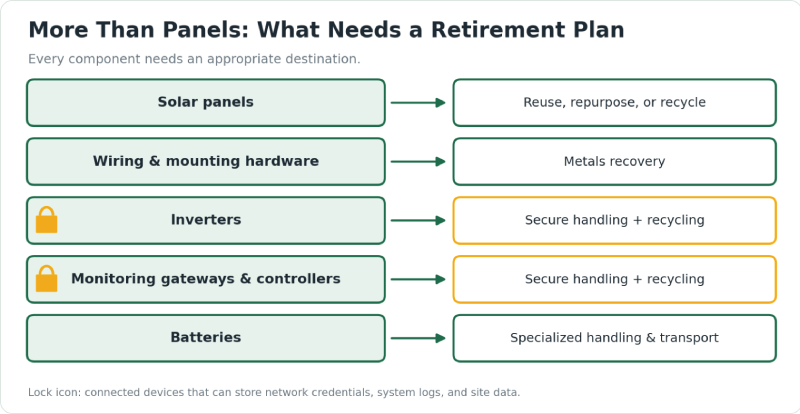
A solar installation is more than panels. It includes wiring, inverters, monitoring equipment, mounting hardware, and sometimes batteries. A retirement plan should account for the whole system and identify an appropriate destination for each component.
Inverters and monitoring equipment are connected devices. Inverters, monitoring gateways, and site controllers can store network credentials, system logs, and site data. When they come out of service, they deserve the same data-security attention as any other networked IT asset. Ask how stored data will be handled before the equipment leaves your site.
Batteries need their own plan. Battery systems, including lithium-ion storage, are subject to their own handling and transport requirements and should not be treated like panels or general scrap.
What Should You Do Before Panels Come Down?
Planning should begin before equipment is removed. For property owners and facility managers, gather:
- Panel make, model, and quantity
- Installation dates
- Maintenance and repair records
- Details of any damage
- Information on inverters, monitoring equipment, and batteries
- Ownership and contract documents, if a third party owns or services the system
These records help qualified professionals evaluate whether equipment can be reused, repurposed, or recycled, and what each path will involve.
Get the Solar Retirement Checklist
A printable version of this list for your facilities team. Email us at hello@4thbin.com and we’ll send it over.
Where Does a Retired Panel Go Next?
Solar power's environmental story continues after electricity generation ends. A retired panel generally has three possible paths:
- Reuse: The panel keeps generating electricity in another installation.
- Repurpose: The panel serves a different, appropriately designed application.
- Recycle: The panel is processed to recover materials such as glass, aluminum, and metals.
The decisions made at retirement determine whether useful equipment and materials get another chapter.

Frequently Asked Questions
How long do solar panels last?
The U.S. Department of Energy estimates that panels made in the last decade will likely last 25 to 35 years, depending on condition and operating circumstances.
Do solar panels have to be recycled when they're removed?
Not always. Panels removed because of roof work, upgrades, or contract changes may still work. A qualified assessment can determine whether reuse is appropriate.
Do inverters and monitoring devices store data?
They can. Inverters, monitoring gateways, and site controllers may store network credentials, logs, and site data, so they should be handled with data security in mind at retirement.
Start Planning with 4THBIN
Planning to replace or retire solar panels? 4THBIN helps organizations across New York, New Jersey, and beyond manage solar equipment retirement responsibly, from assessment and reuse options to certified recycling and secure handling of connected equipment. contact our team to discuss your project.
Next in the series: Can retired solar panels be safely reused or repurposed?
Shining Light on Solar Panel Recycling - A Four Part Series from 4THBIN