HIPAA Compliant Destruction and Recycling of X-Ray Film

Imagine you’re a healthcare facility manager with piles of outdated X-ray films. You know they contain sensitive patient data, but they’re taking up valuable storage space. You also know that improper disposal could lead to a privacy breach or even hefty fines. It’s a dilemma that’s faced by healthcare providers across the country. What’s the right way to dispose of them securely, without violating HIPAA or damaging the environment?
For covered entities and business associates, improper disposal of X-ray films is not just a housekeeping issue. It is a regulatory liability. The HIPAA Privacy Rule requires healthcare organizations to implement safeguards that ensure protected health information cannot be accessed, reconstructed, or disclosed during disposal.
According to the Health Insurance Portability and Accountability Act (HIPAA), X-rays must undergo a unique disposal process as they contain protected health information (PHI).
At 4THBIN, we understand the challenges of HIPAA-compliant disposal. We’re here to guide you through every step to ensure your X-ray films are handled securely and responsibly.
What Are X-Ray Films Made Up Of?
Before we move on to its disposal, let us first understand the composition of X-rays. X-rays are typically made of polyethylene terephthalate (PET) plastic and coated with an emulsion layer containing silver halide. When silver halide is exposed to heat, it turns black, capturing an image during the X-ray procedure. While most medical facilities have transitioned to digital imaging, physical X-ray films remain prevalent, making their destruction and recycling a concern.
HIPAA Requirements for X-Ray Destruction
Under the HIPAA Privacy Rule (45 CFR §164.530(c)), covered entities must implement appropriate administrative, technical, and physical safeguards to protect PHI during disposal. The Department of Health and Human Services (HHS) makes clear that disposal must render PHI unreadable, indecipherable, and otherwise irretrievable.
Before 2004, most X-rays were made of plastic and stored for longer periods due to record retention policies. Today, with the new record retention policy that mandates shorter retention periods, X-rays are eligible for destruction.
As mentioned above, X-ray films contain protected health information (PHI) that is either related to an individual’s health or may contain personal information about the individual. Given this nature, HIPAA requires X-ray films to be destroyed so they cannot be reconstructed.
Under HIPAA, healthcare facilities and providers are responsible for maintaining and properly disposing of X-ray films. As per federal law, these X-rays and medical records may be retained for at least 7 years for adults and 18 years for minors before their disposal.
However, these are subject to change based on local state laws and regulations. For example, healthcare providers in New York must keep X-rays and medical records for at least six years before destroying and disposing of them.
HIPAA allows healthcare facilities and providers to perform on-site or off-site destruction, provided that the confidentiality of the information is maintained.
If a facility proceeds to destroy its X-ray films on-site, it must ensure they are completely shredded and permanently destroyed. However, if a healthcare facility is outsourcing X-ray recycling to a company, it must obtain a “Certificate of Destruction” confirming the safe destruction of PHI.
The Importance of HIPAA Destruction & Recycling of X-Ray Films
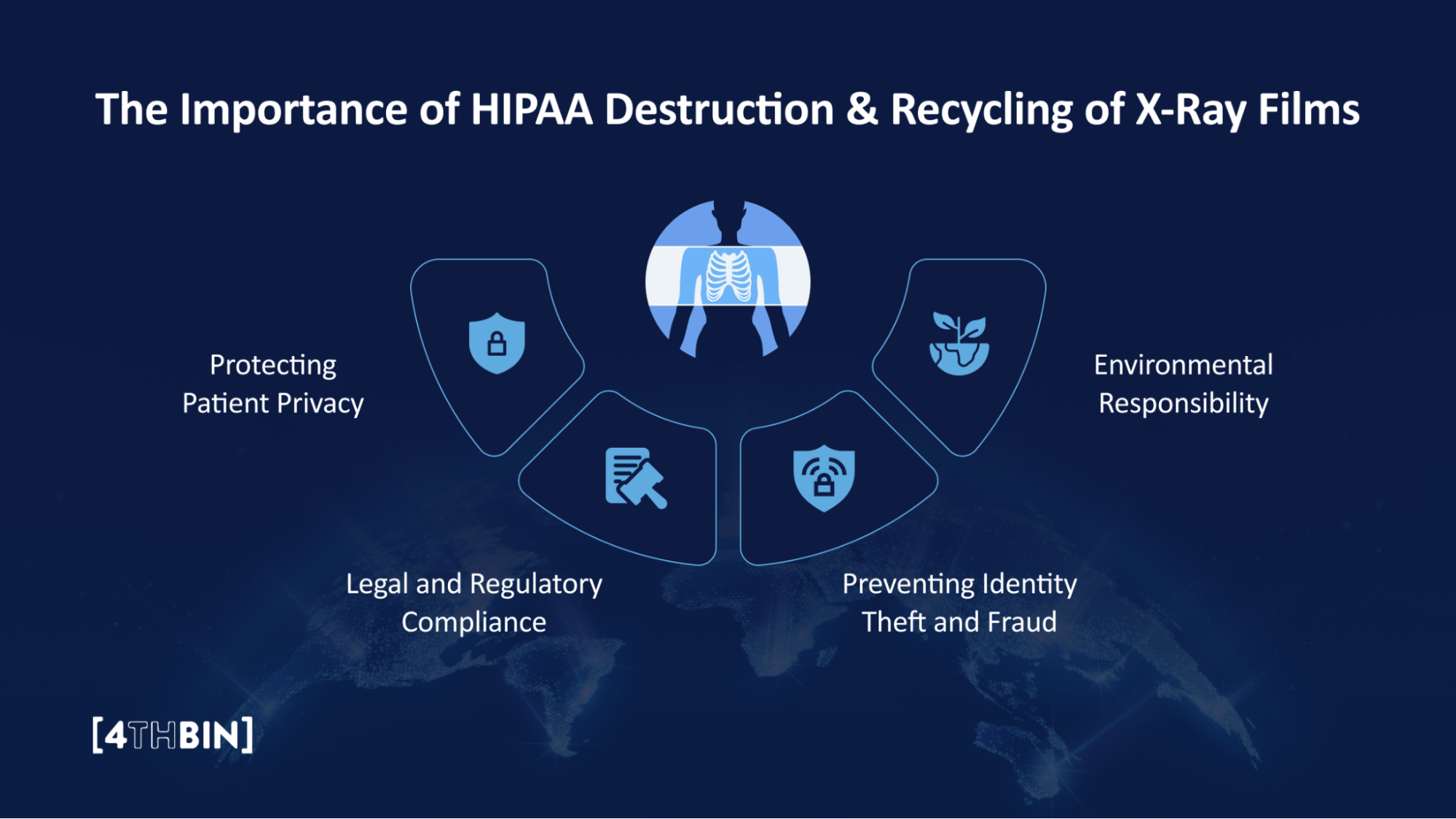
Here is why healthcare facilities and providers must destroy their X-ray films as per HIPAA guidelines:
Protecting Patient Privacy
When X-ray films are disposed of improperly, it can lead to unauthorized access and potential misuse of this information. HIPAA mandates that all PHI must be appropriately destroyed to prevent patient privacy breaches. By adhering to HIPAA guidelines, healthcare facilities can maintain patient confidentiality, enabling trust and security in their services.
Legal and Regulatory Compliance
Enforcement actions related to improper document disposal are not uncommon. In several cases, healthcare providers have faced penalties after patient records were discovered in unsecured dumpsters or recycling bins. Regulators evaluate whether reasonable safeguards were implemented, and failure to do so can result in corrective action plans, civil penalties, and reputational damage.
Non-compliance with HIPAA regulations can result in significant legal and financial repercussions for healthcare providers. Penalties for HIPAA violations can range from hefty fines to criminal charges, depending on the severity of the breach. These fines can vary from $100 to $50,000 and go up to $250,000 for repeat violations.
Proper destruction of X-ray films is not just a best practice but a legal requirement to avoid these consequences. Moreover, healthcare providers adhering to HIPAA standards are committed to ethical practices and regulatory adherence, safeguarding their organizations from potential lawsuits and penalties.
Preventing Identity Theft and Fraud
With improper disposal of X-ray films, sensitive and personal information may fall into the wrong hands. Malicious actors can use the information on discarded films to create false medical records, commit insurance fraud, or steal identities. HIPAA-compliant destruction methods, such as shredding or incineration, render X-ray films unreadable and irrecoverable, protecting patients from the far-reaching impacts of identity theft and fraud.
Environmental Responsibility
Properly destroying X-ray films is an environmentally responsible practice, as well as a means of protecting patient information. As mentioned, X-ray films contain silver, which can harm the environment if disposed of incorrectly. HIPAA-compliant destruction often includes recycling programs that safely extract and reuse these materials, reducing their environmental impact.
Moreover, recycling X-rays contributes to a circular economy by preventing plastic and valuable materials like silver from ending up in landfills and reducing the need for new raw materials. Extracting silver from X-rays can also yield a significant monetary profit of up to $35,000. Reintroducing these recovered materials into the production cycle supports sustainable resource management and minimizes environmental impact.
Steps for Responsible Recycling of X-Ray Film
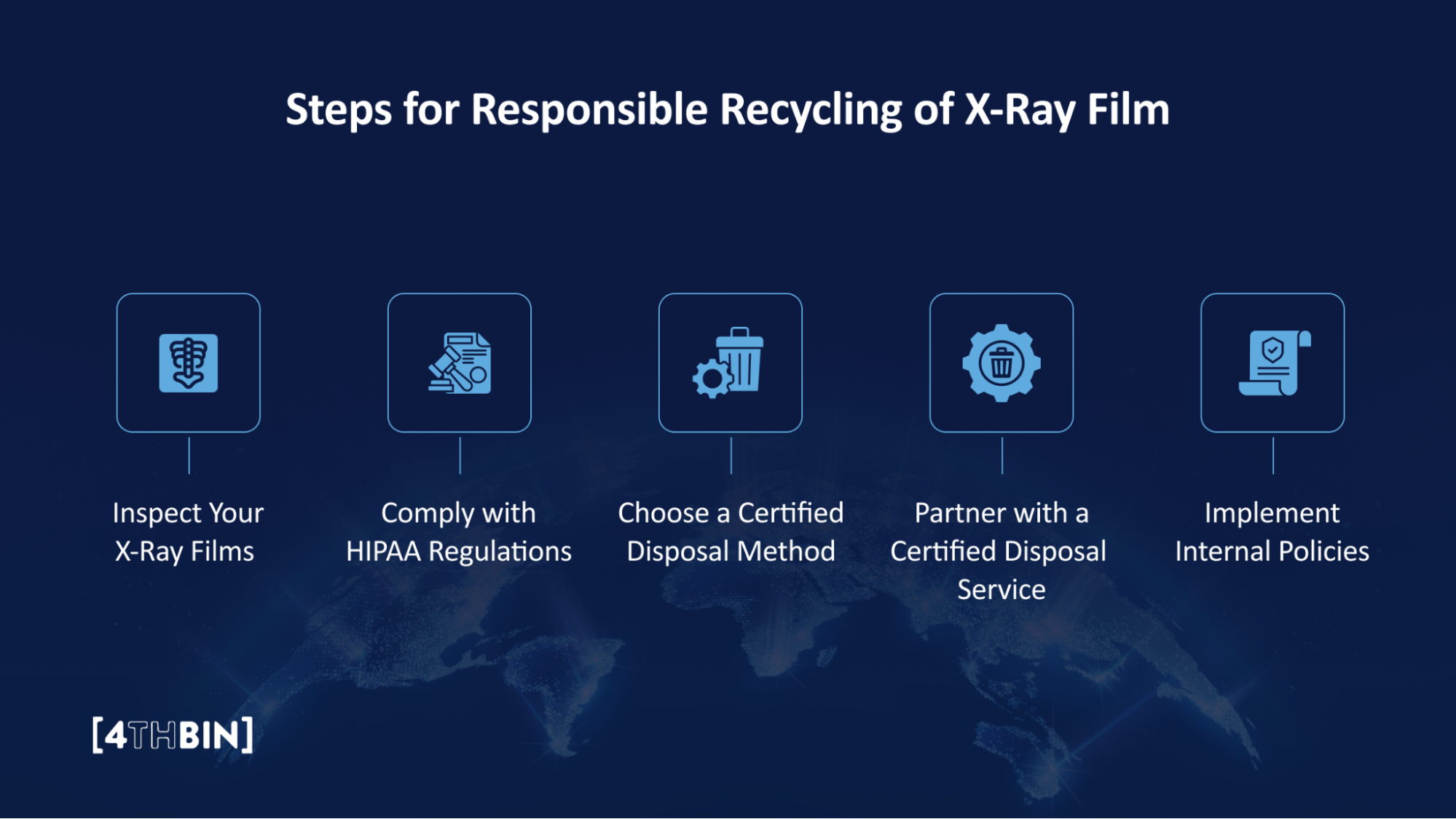
With proper disposal of X-ray films, healthcare facilities can protect patient information, avoid legal repercussions, and contribute to a greener environment. Here is a step-by-step process your facility can follow to ensure the proper recycling of X-ray films:
Inspect Your X-Ray Films
The first rule of X-ray recycling is to identify X-rays that are no longer needed. Your facility must begin by assessing all existing X-ray films. This involves determining which films are outdated, no longer required for patient care, or past their retention period. If they no longer serve a purpose, they must be disposed of.
Comply with HIPAA Regulations
The next step would be to ensure your facility adheres to HIPAA guidelines to protect patient information. You must begin by familiarizing yourself with HIPAA requirements for the safe destruction of PHI. If your facility opts for off-site X-ray destruction, you must store them in a secure location until they are ready for disposal, preventing unauthorized access.
Choose a Certified Disposal Method
Once you know HIPAA regulations, you must recycle PHI in accordance with certified disposal and recycling methods that ensure its destruction and comply with legal and environmental standards. Here are a few methods to ensure the HIPAA-compliant destruction of X-ray films:
- Shredding: X-ray films are shredded into small pieces, making it impossible to reconstruct any information.
- Incineration: Films are burned in high-temperature incinerators, destroying the data and materials.
- Chemical Destruction: Certain chemical processes can break down the film’s emulsion layer, erasing personal information.
- Recycling: Specialized recycling programs extract valuable materials like silver while ensuring that all PHI is destroyed in the process.
Regardless of the method selected, documentation of the destruction process should be maintained for audit purposes. Proper chain-of-custody procedures further demonstrate compliance in the event of regulatory review.
Partner with a Certified Disposal Service
When outsourcing X-ray film destruction, healthcare providers must establish a Business Associate Agreement (BAA) with the disposal vendor. This agreement ensures the vendor safeguards Protected Health Information (PHI) and complies with HIPAA standards, reducing liability for the healthcare organization.
It’s crucial to partner with a reputable, certified disposal service. Before choosing a vendor, verify their credentials to ensure they are equipped to handle and destroy X-ray films in line with HIPAA requirements.
Finally, upon completion of the destruction, obtain a “Certificate of Destruction” as proof that the X-ray films were securely disposed of in accordance with HIPAA guidelines.
Implement Internal Policies
The last step is to develop and enforce internal policies within your facility regarding the disposal of X-ray films. These policies should establish clear guidelines for handling, storing, and disposing of X-ray films. You must also educate your staff on the importance of responsible disposal and the steps they must follow to ensure compliance.
By following these steps, healthcare providers ensure that X-ray films are disposed of responsibly and uphold the healthcare facility's integrity and reputation.
Declutter & Safely Dispose of X-rays with 4THBIN!
Is your organization struggling to recycle its X-rays? 4THBIN can help. X-ray film requires specialized handling. It contains protected health information and recoverable silver, both of which require secure, compliant processing.
With over a decade of experience, 4THBIN supports more than 10,000 organizations across the United States with certified, secure e-recycling and data destruction services. We operate in compliance with HIPAA, HITECH, NIST 800-88 standards, and maintain NAID AAA and e-Stewards® certifications.
From secure chain-of-custody handling to certified X-ray film destruction and silver recovery, our solutions protect patient data while supporting your sustainability goals.
Ensure Safe Disposal & Recycling of X-Rays!
Frequently Asked Questions
1. Why can’t I dispose of X-rays with regular waste?
X-ray films contain Protected Health Information (PHI) and are therefore subject to HIPAA regulations. Improper disposal can lead to privacy breaches and legal consequences. HIPAA requires that all PHI be securely destroyed to prevent unauthorized access or misuse.
2. What are the legal requirements for destroying X-ray films?
Under HIPAA, healthcare providers must ensure X-ray films are destroyed in a manner that makes them irretrievable. X-rays must be retained for a specific period (at least 7 years for adults, 18 years for minors) before being destroyed, although local state laws may differ.
3. What methods are used to destroy X-ray films?
X-ray films can be destroyed using several methods, including shredding, incineration, and chemical destruction. Many facilities also use recycling programs to recover valuable materials like silver while ensuring the destruction of PHI.
4. How do I ensure my X-ray disposal service is HIPAA-compliant?
To ensure compliance, partner with a certified disposal service specializing in the secure destruction of medical records. You should also obtain a “Certificate of Destruction” to verify that the X-rays were properly destroyed in accordance with HIPAA guidelines.
5. Can I recycle X-ray films?
Yes, X-ray films can be recycled. Specialized programs safely extract materials like silver, which can be reused, and ensure that all PHI is destroyed during the process. Recycling X-ray films helps minimize environmental impact and supports sustainable practices.