What is Sustainable Compliance in E-Waste Recycling?

A recent study found that while corporate e-waste continues to increase, fewer than 30% of organizations have a documented and compliant process for retiring, recycling, or disposing of their electronics.
And among those that do, very few can prove where those devices end up, or whether the data they hold was ever properly erased.
In many companies, old equipment is quietly handed off to IT or operations teams. Devices are donated without data destruction or sent to vendors who offer little to no downstream visibility. Sometimes, they’re shipped overseas or dumped in landfills, untraceable until a regulator or auditor comes knocking.
Today’s businesses face tighter regulations and rising pressure from stakeholders demanding real accountability. One thing is clear: sustainability goals can no longer be met through vague recycling claims; they require explicit, documented action.
Yet e-waste remains one of the most overlooked parts of modern compliance strategy.
This is where sustainable compliance comes in. It ensures your e-waste practices are secure, transparent, and aligned with legal and environmental expectations.
In this blog, we’ll break down what sustainable compliance means, where most businesses fall short, and how you can build a secure, transparent, and environmentally responsible process.
What is Sustainable Compliance?
As businesses become more reliant on technology, the question of what to do with retired devices is more critical than ever. It’s not just about discarding electronics, it’s about doing it responsibly, legally, and in a way that protects both people and the planet. That’s where sustainable compliance comes in.
Sustainable compliance in e-waste recycling means aligning your disposal practices with both regulatory standards and environmental responsibility. It’s about committing to a broader vision of accountability that includes secure data handling, ethical downstream practices, and reducing harm to ecosystems and communities.
For organizations, this means choosing recycling partners who not only meet the minimum legal requirements but also hold certifications, have auditable processes, and help you support your ESG goals. It’s an approach that’s proactive and one that’s becoming a business essential in today’s climate-conscious world.
Standards That Define Responsible E-Waste Recycling
Sustainable compliance is built on clear regulations and certifications that guide how e-waste should be managed. These standards protect public health, ensure environmental responsibility, and promote ethical practices throughout the recycling chain. Here are some of the most critical frameworks businesses must pay heed to:
R2v3 (Responsible Recycling Standard)
One of the most widely adopted global certifications, R2v3 sets strict requirements for secure data destruction, environmental protection, and downstream accountability. It ensures that recyclers manage devices in a way that minimizes risk to both the environment and the organizations disposing of them.
e-Stewards Certification
The e-Stewards Certification is a standard that goes beyond environmental protections. It prohibits the export of hazardous e-waste to developing countries and ensures that workers involved in recycling operations are treated ethically. It’s often the preferred standard for organizations with strong corporate social responsibility (CSR) goals.
EPA Regulations
In the U.S., the Environmental Protection Agency (EPA) enforces rules regarding the handling and disposal of hazardous electronic components, such as lithium batteries, CRTs, and mercury-containing equipment. Violations can result in steep penalties and cleanup costs.
State-Level EPR Laws
Extended Producer Responsibility (EPR) laws require electronics manufacturers and handlers to fund and manage recycling programs. These vary by state but are becoming increasingly common and complex. Working with a certified recycler helps ensure consistent compliance across regions.
These standards help set the foundation for responsible e-waste recycling. By following them, businesses can stay compliant, protect data, and minimize environmental impact while staying prepared for what’s ahead.
The Cost of Getting E-Waste Compliance Wrong
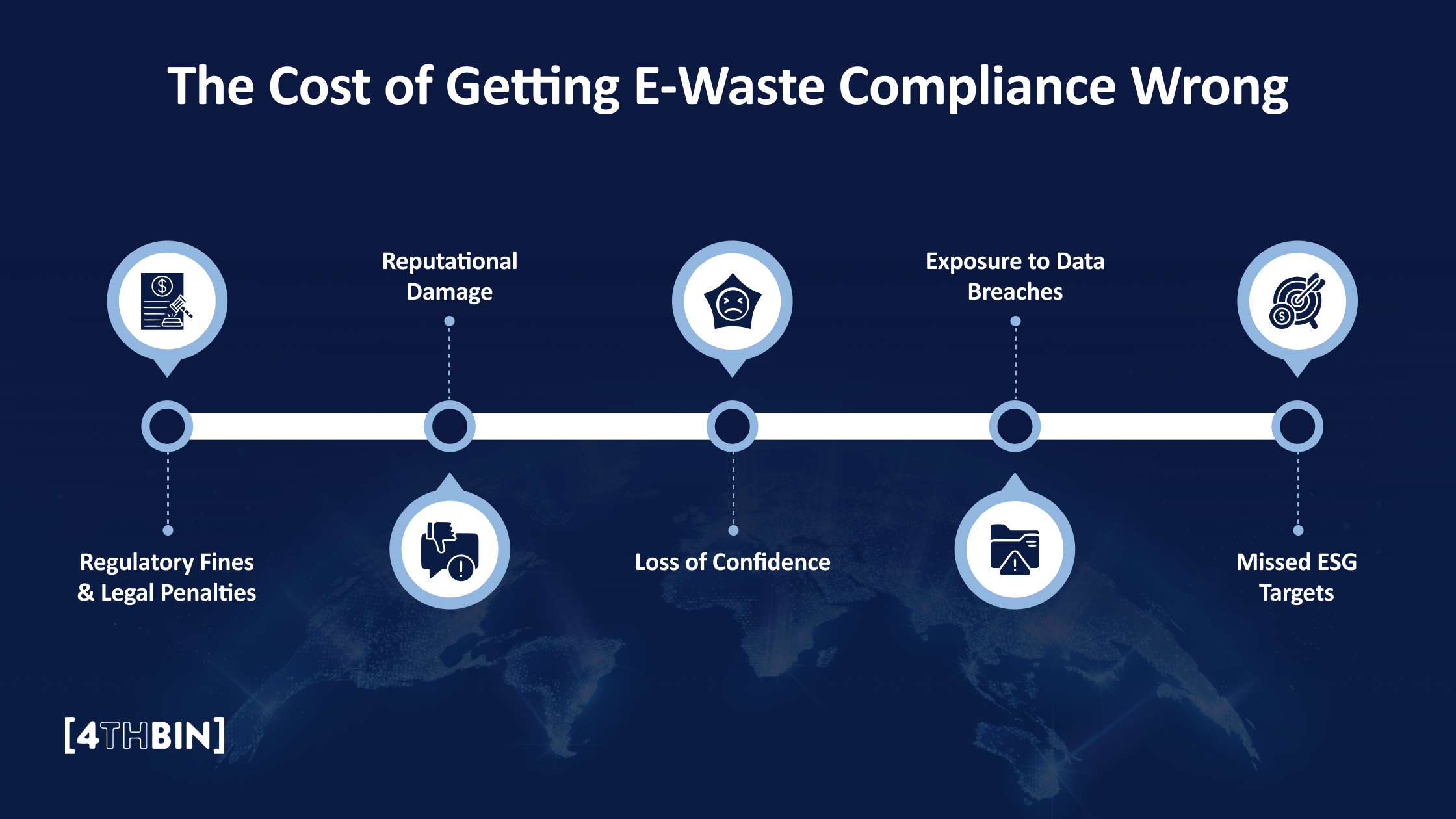
Many businesses underestimate the consequences of improper disposal until it’s too late. The fallout can affect far more than just your IT team, from legal trouble to reputational damage. Here’s what’s at stake when companies cut corners on e-waste compliance:
Regulatory Fines & Legal Penalties
Failure to comply with e-waste regulations, whether at the federal, state, or international level, can lead to serious financial and legal consequences. For instance, under the EPA’s Resource Conservation and Recovery Act (RCRA), companies that improperly dispose of hazardous materials, such as mercury, lead, or lithium batteries, may face fines that can escalate to hundreds of thousands of dollars.
Many U.S. states, including New York and California, also enforce Extended Producer Responsibility (EPR) laws, which require manufacturers and recyclers to follow specific collection and reporting practices. Violations not only trigger fines but often mandate corrective action plans, public disclosure, and stricter oversight going forward.
Reputational Damage
When electronics are discarded without oversight, they can end up in places that conflict with your company’s stated values, such as unregulated dumpsites, informal recycling markets, or unsafe processing facilities abroad. If traced back to your organization, this can spark backlash across your customer base, industry partners, and sustainability community.
In an era where transparency and accountability are tied directly to brand perception, even a single lapse in ethical e-waste handling can raise questions about your company’s broader integrity. The reputational recovery process can be long and expensive, often requiring crisis communications, audits, and revised public commitments to rebuild trust.
Loss of Confidence
Customers, employees, and investors now expect businesses to act responsibly across their supply chains, including at the end-of-life stage for technology. Suppose your disposal practices fall short, whether due to lack of certification, traceability, or transparency, it creates a gap between what your brand claims and what it does. This disconnect can have tangible effects: customers may reconsider long-term loyalty, employees may question internal priorities, and investors may reevaluate your ESG performance. For public companies, this may also affect sustainability indices or shareholder activism efforts.
Exposure to Data Breaches
Every decommissioned device is a potential vulnerability if not handled correctly. Hard drives, solid-state storage, printers, and even smartphones can contain proprietary business data, financial records, client files, or personal health information. If these aren’t securely wiped or physically destroyed by a certified recycler, they may be recoverable, even if they appear to be erased.
A single breach can lead to exposure under laws such as the General Data Protection Regulation (GDPR), the Health Insurance Portability and Accountability Act (HIPAA), or the California Consumer Privacy Act (CCPA). Beyond fines, businesses often face class-action lawsuits, forensic investigations, mandatory breach notifications, and loss of client trust—all from mishandling a device someone thought was “off the books.”
Missed ESG Targets
Many companies today operate under formal ESG mandates or pursue certifications like ISO 14001, B Corp, or LEED to validate their sustainability efforts. These frameworks require more than intent—they need documentation, traceability, and third-party verification of environmental practices. If your e-waste disposal is undocumented, outsourced without oversight, or fails to meet recognized standards, it becomes a gap in your compliance reporting. This not only jeopardizes your ability to meet internal sustainability KPIs, but it may also limit your eligibility for government contracts, corporate partnerships, or investment opportunities that depend on verified ESG performance.
Why Businesses Should Prioritize Sustainable Compliance
When it comes to managing retired electronics, many companies focus on logistics—getting devices off-site, wiping data, and possibly recycling. But the real value comes from taking a broader, more responsible approach. Sustainable compliance isn’t just about doing what’s required. It’s about doing what’s right for your business, your stakeholders, and your long-term goals. Here’s why it matters:
Keep Up with Changing Regulations
E-waste laws are no longer limited to a few regions or industries. New standards are emerging around how electronics must be recycled, how data must be destroyed, and how disposal must be documented.
In the U.S., states like New York, California, and Illinois already enforce strict recycling and take-back rules. Internationally, the WEEE Directive in the EU places the responsibility for end-of-life management on manufacturers. Regulations like these aren’t static—they’re expanding.
By prioritizing compliance today, you avoid last-minute scrambles to meet new requirements. Your business is better prepared for inspections, audits, or shifts in legislation, and you won’t need to overhaul your process when something changes; you’ll already be doing things the right way.
Avoid Costly Mistakes
When electronics are mishandled, the damage doesn’t stop at a fine. Legal penalties often come with follow-up audits, required corrective actions, and internal reviews that drain time and resources. A single missed step, such as failing to wipe a device or using an uncertified recycler insecurely, can trigger data breaches, lawsuits, or public scrutiny.
And it’s not just about penalties. The operational disruption of responding to compliance failures, such as communicating with affected stakeholders, updating policies, and retraining staff, can take weeks or months. Building a compliant process from the start is far more cost-effective than trying to clean up after something goes wrong.
Maintain Trust with Stakeholders
Whether it’s a client performing due diligence, a board evaluating ESG performance, or a team member reviewing company values, how you handle e-waste is part of the bigger picture. Stakeholders want to know that your operations align with your commitments to privacy, sustainability, and corporate responsibility.
When your process is documented, traceable, and aligned with established standards, it sends a clear message: your company pays attention to the details. That matters—not just to auditors and regulators, but to the people who support, fund, and work for your business.
Support Your ESG Goals
Many businesses today have ESG policies on paper, but struggle to back them up with real numbers. E-waste is often overlooked, yet it’s one of the most measurable ways to demonstrate environmental action. When you recycle devices responsibly, work with certified vendors, and track material outcomes, you generate data that can be used in sustainability reporting.
That data matters—especially for companies pursuing certifications, responding to investor requests, or publishing annual impact reports. It also supports internal decision-making by helping you identify where waste can be reduced or where policies can be strengthened.
Simplify Internal Processes
Without a clear system in place, handling e-waste can become a burden on IT, facilities, or procurement teams. Devices pile up in closets. Policies vary between offices. Asset disposal becomes an afterthought instead of a secure, documented process.
By making sustainable compliance part of your operations, you reduce confusion and create consistency. Teams know what to do when a device is decommissioned. There’s a clear process to follow. Reporting becomes faster, and maintaining accountability becomes easier. It’s a simple change that makes day-to-day management more organized and less reactive.
What Does a Sustainable Compliance Workflow Look Like?
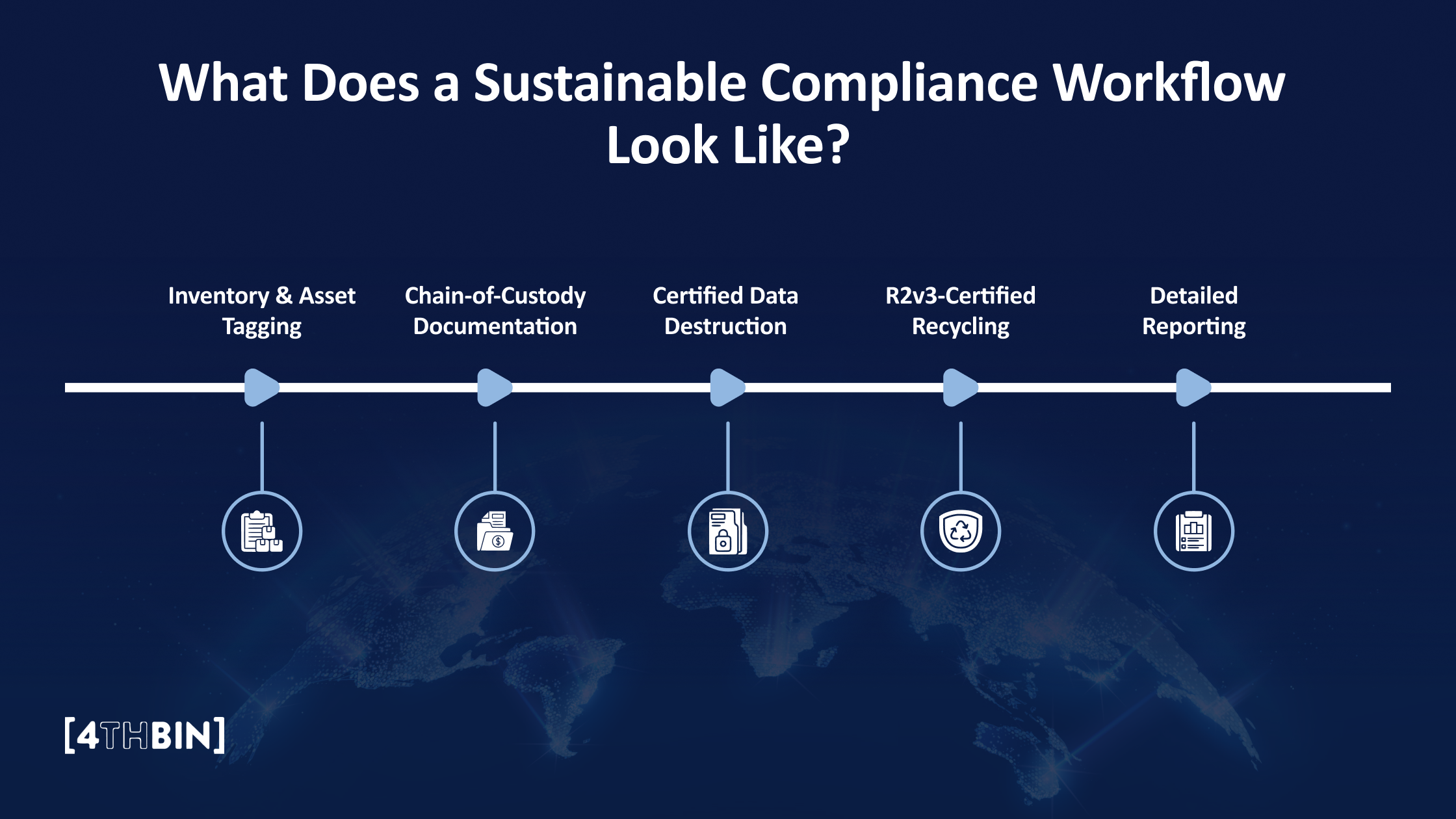
Understanding the why behind sustainable compliance is one thing, but knowing how to implement it is where many businesses get stuck. Here’s what a practical, end-to-end sustainable compliance workflow should include:
Inventory & Asset Tagging
Start with a clear inventory of all electronic devices scheduled for decommissioning. Each item should be tagged with a unique identifier, such as a serial number or internal asset ID, to ensure it can be tracked through every step of the process. This creates accountability from the moment the device leaves your possession.
Chain-of-Custody Documentation
Once collected, devices must be handled through a documented chain of custody. This includes who picked up the equipment, where it was taken, and when it changed hands. Every handoff should be logged to ensure complete traceability and eliminate any blind spots in the process.
Certified Data Destruction
Data-bearing devices should undergo secure, verifiable data destruction methods, such as physical shredding or NIST 800-88-compliant data wiping. You should receive a Certificate of Data Destruction for each asset processed, ensuring legal compliance and mitigating the risk of data breaches.
R2v3-Certified Recycling
All materials should be processed by an R2v3-certified facility. This certification ensures that your electronics are dismantled, recycled, or disposed of in accordance with industry-recognized environmental and ethical standards. It also means downstream vendors are held to the same level of accountability.
Detailed Reporting
At the end of the process, your recycling partner should provide detailed documentation that can support internal compliance efforts, audits, and ESG reporting. This includes breakdowns of materials recovered, landfill diversion percentages, and emissions avoided, helping you demonstrate the environmental value of your program.
When all of these steps are in place, compliance becomes more than a policy. It becomes part of your standard operating procedure. And when done right, it’s seamless, strategic, and benefits your business in the long run.
Achieve Sustainable Compliance at Every Step with 4THBIN
Sustainable compliance is about building a process that protects your business, your data, and the environment, while reinforcing the values your stakeholders care about most. 4THBIN offers certified, fully traceable e-waste recycling solutions that help you meet legal requirements, protect sensitive data, and support your ESG goals.
With over a decade of experience, 4THBIN has partnered with more than 10,000 organizations, including Fortune 100 companies and small businesses, to transform e-waste challenges into opportunities. We make the process seamless, offering businesses a way to turn a potential liability into an opportunity for leadership in sustainability and responsibility.
Our certified data destruction services ensure that sensitive information is completely safeguarded, eliminating the risks of data recovery associated with improper disposal. From secure RemoteReturn mail-in options to convenient on-site collection, our customizable solutions allow you to choose the plan that best suits your organization’s needs.
Turn E-Waste Risk into Business Value.
Contact Us