The Economic Benefits of Recycling E-Waste

About 40 million tons of e-waste are generated each year globally, and the number continues to climb as businesses upgrade technology at an accelerating pace. According to global estimates, approx 300 million computers and 1 billion cellphones are replaced annually, often long before they reach the end of their usable life.
Now consider a typical enterprise refresh cycle. A company replaces hundreds or even thousands of laptops, smartphones, and tablets at once. In many cases, those devices don’t immediately get recycled. They sit in storage rooms, IT closets, or warehouses, waiting for a decision that often gets delayed. Over time, what was once a valuable asset quietly turns into a sunk cost.
At the same time, those devices still contain high-value materials like gold, copper, and rare earth elements. When they are discarded without structured recovery, that value is lost along with the resources and energy used to produce them in the first place.
But this is where the narrative shifts. What if retired technology wasn’t treated as waste at all? What if it were managed as a recoverable asset, one that could generate revenue, reduce procurement costs, and support job creation?
That is exactly where e-waste recycling comes in. When done right, it transforms discarded electronics from a liability into a measurable economic opportunity, extending value far beyond their initial use.
As one of the fastest-growing waste streams globally, e-waste contains a hidden wealth of materials, from gold and silver to copper and rare-earth metals, ready to be extracted, reused, and sold.
This blog will explore how organizations can utilize e-waste recycling to tap into this economic potential, transforming yesterday’s tech into tomorrow’s valuable assets.
The Economic Benefits of E-Waste Recycling
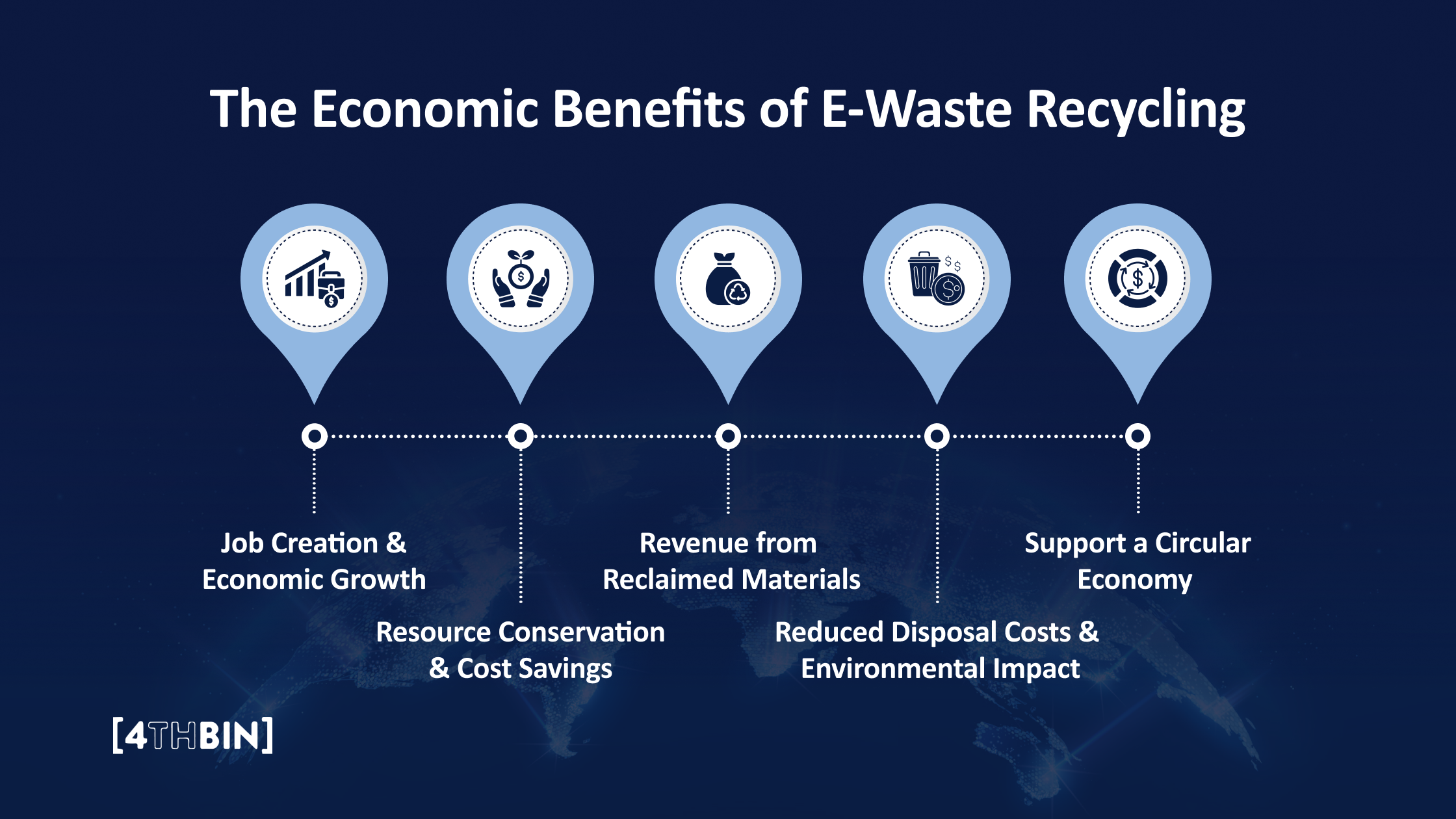
Recycling e-waste goes far beyond environmental impact, offering unexpected advantages for economies and businesses. Here are a few economic benefits of e-waste recycling that companies must consider:
Job Creation and Economic Growth
Recycling e-waste isn’t just about protecting the environment; it’s also a powerful means for job creation and economic growth. Unlike conventional waste management, which often involves minimal sorting, e-waste recycling requires skilled labor to dismantle, process, and safely repurpose electronic parts. This demand creates various job opportunities in recycling centers, from hands-on technical roles to positions in logistics and administration.
A report revealed that if a single state in the US recycled 100% of its electronic waste, it would create over 1,738 direct jobs and 3,345 new jobs. Communities that invest in e-waste recycling programs experience an economic ripple effect. Jobs created in recycling centers drive local spending, supporting other local businesses. For example, workers in recycling facilities contribute to the economy by spending their earnings on housing, food, and services nearby, facilitating regional economic activity.
Resource Conservation and Cost Savings
An estimated $57 billion worth of gold, silver, copper, platinum, and other recoverable metals was dumped and burned rather than recovered and reused. In such a scenario, e-waste recycling not only fulfills an environmental responsibility but is also a financially wise move for manufacturers.
By recovering valuable materials like gold, silver, copper, and rare earth elements from old electronics, companies reduce their dependence on standard mining processes, which are both costly and environmentally taxing.
Through recycling, manufacturers tap into a steady stream of materials that help them cut production costs and stabilize their supply chains. In fact, reports reveal that recycling e-waste can recover enough silver to manufacture 440,000 solar panels and enough copper for 155,000 electric vehicles.
Moreover, incorporating recycled materials into new products gives companies a competitive edge. By using reclaimed metals and components, they can protect themselves from scaling demand and raw material price fluctuations and ensure that their production costs stay predictable even in uncertain markets. This approach isn’t just cost-saving; it’s also an effective way for manufacturers to show they prioritize sustainable production, which appeals to today’s eco-conscious consumers.
Some of the largest tech companies, like Apple, have already embraced this model. They have committed to using 100% recycled cobalt in all Apple-designed batteries by 2025. That’s not all; their printed circuit boards also use 100% recycled tin soldering and gold plating. By choosing e-waste recycling, manufacturers conserve resources, stabilize operations, and enhance their brand’s appeal, all while reducing their environmental impact.
Revenue from Reclaimed Materials
The financial benefits of recycling e-waste go beyond cost savings; e-waste has become a source of revenue. Electronics contain a range of precious metals and rare earth elements that are valuable and increasingly in demand. Gold, silver, and copper, commonly found in discarded electronics, hold significant market value when extracted and resold.
In 2022, the estimated value of metals embedded in global e-waste was approximately $91 billion. This includes around $19 billion in copper, $15 billion in gold, and $16 billion in iron. Moreover, it is revealed that if the single state of Minnesota recycles all of the e-waste it produces, approximately 266 million pounds of e-waste every year, it will recover 78 million pounds of valuable materials, which will cost over $2.8 billion annually.
For businesses, recycling e-waste presents an opportunity to turn obsolete electronics into profit. Companies can partner with e-waste recycling firms to recover these high-value materials, effectively monetizing their old electronics and generating an additional revenue stream. This process isn’t just good for business; it’s a solution that reduces the need for mining, conserves natural resources, and supports a more sustainable economy.
Reduced Disposal Costs & Environmental Impact
Recycling e-waste reduces costs at both the business and municipal levels. Organizations that refrain from dumping e-waste directly into landfills save on disposal fees and waste management expenses. Managing this hazardous electronic waste in landfills is expensive and risky for municipalities due to potential soil and water contamination.
Companies avoid these costs by choosing recycling and contributing to a cleaner, safer environment. Recycling facilities are equipped to handle and safely extract hazardous materials like lead, mercury, and cadmium, keeping these toxins out of landfills and reducing public health risks. Reducing environmental and health risks saves public funds that would otherwise be spent on cleanup efforts and pollution-related healthcare expenses.
Moreover, governments often incentivize e-waste recycling with tax benefits or grants, further enhancing the financial benefits for participating businesses. With the right recycling partnerships, companies can transform waste into assets, making e-waste recycling an economically sound strategy for businesses and communities.
Support a Circular Economy
As mentioned above, electronic devices contain various valuable materials like iron, copper, and gold. When they are improperly disposed of or go unrecovered, it can lead to a loss of $57 billion. Only $10 billion is recovered environmentally sound, while the rest piles up in landfills or the open environment.
E-waste recycling is essential to building a circular economy, where products and materials are continuously reused and repurposed instead of ending up as waste. In a circular economy, companies can keep valuable resources in circulation, minimizing the need for raw materials and reducing environmental strain. Recycling e-waste fits perfectly within this model, turning discarded electronics into resources for new products.
The circular economy promotes economic resilience and innovation. When companies prioritize sustainable resource use, they invest in creating longer-lasting products and processes, which drive new design, manufacturing, and recycling innovations. By recycling e-waste, businesses reduce their reliance on finite resources and position themselves as forward-thinking leaders in sustainability, attracting customers who prioritize environmentally responsible brands.
Companies adopting circular economy principles can deliver lasting economic benefits, drive recycling innovation, and support global sustainability goals. By supporting e-waste recycling, businesses contribute to a healthier planet and a more resilient, adaptable economy.
Make Your Organizational E-Waste Count with 4THBIN
Managing electronic waste effectively is essential, not only for environmental reasons but also to protect your organization’s data and capture economic value.
4THBIN offers reliable, certified e-recycling solutions that simplify e-waste management and highlight the financial and environmental benefits.
With over a decade of expertise, 4THBIN has partnered with over 10,000 organizations across the United States, including Fortune 100 companies and startups, to transform e-waste into a valuable resource.
We prioritize data security and environmental impact, ensuring that sensitive information is completely safeguarded with our certified data destruction services. This eliminates the risks of data recovery associated with improper disposal.
Our customizable e-waste recycling solutions include secure RemoteReturn mail-in services and convenient on-site collection options, allowing you to choose a plan that best fits your organization’s needs.
Maximize Your Returns Today.
Contact Us
Frequently Asked Questions
1. What materials can be recovered from e-waste during recycling?
E-waste contains valuable materials such as gold, silver, copper, platinum, and rare earth metals. These materials can be extracted, purified, and reused to reduce the environmental impact of mining, while providing a sustainable source of metals for manufacturing.
2. How does e-waste recycling create job opportunities?
E-waste recycling creates a range of skilled and unskilled jobs in the recycling industry, including roles in dismantling, processing, logistics, and administration. For example, if a state were to recycle 100% of its e-waste, it could create thousands of new jobs, benefiting the local economy.
3. What are the environmental benefits of e-waste recycling?
E-waste recycling helps reduce the harmful effects of improper disposal, such as soil and water contamination from toxic metals like mercury and lead. By recycling, these toxic substances are safely extracted, minimizing environmental pollution and public health risks.
4. How does e-waste recycling help businesses save costs?
By recovering valuable metals and components from old electronics, businesses can reduce their reliance on costly raw materials. E-waste recycling also lowers disposal fees, mitigates the risk of pollution-related fines, and stabilizes the supply chain by ensuring the availability of recycled materials.
5. Why is e-waste recycling important for building a circular economy?
E-waste recycling supports the circular economy by transforming discarded electronics into reusable resources, minimizing the need for virgin materials. This reduces environmental impact, promotes sustainable manufacturing, and creates a more resilient economy where materials are continuously recycled and repurposed.