Living Sustainably: A Practical Guide to Everyday Change

What does it mean to build a future that lasts—and how close is the world to achieving it? In 2024, the U.S. installed 50 gigawatts (GW) of new solar capacity. That made up 84% of all new electricity generation that year.
Such a shift marks more than a power change. It reflects a deeper choice—towards a life that works with nature, not against it.
Still, solar panels alone cannot solve the larger problem. Land, water, waste, air—every part of life connects to the climate. And every sector holds some share of the solution. The shift begins not in labs or laws alone but in how communities live daily.

A sustainable living guide does not aim to simplify the crisis. It exists to break it down into parts that can be addressed with clarity, skill, and resolve.
What is Sustainable Living?
Sustainable living has three core dimensions: economic, environmental, and social.
These areas do not work in silos. Each shapes the others through shared gains or trade-offs. A sustainable system must balance all three, not just strengthen one at the cost of the rest.
Economic sustainability involves long-term growth without harming natural or social systems. Key signals include steady revenue, fair terms of trade, and constant investment in research and clean tech. In this space, energy use, waste cycles, and supply chains matter as much as output or profit.
Environmental sustainability focuses on resource use and waste. The clearest indicators include CO₂ balance, water and air quality, biodiversity, and non-renewable emissions. Living with this lens means tracking every draw on the system—electricity, transport, land use—and finding ways to close loops.
Social sustainability reflects how well systems serve people. Fair wages, equal access to health and school, stable work, and safe homes—all feed into sustainable outcomes. A low-impact city that displaces poor groups fails on this front.
The point of overlap—where all three align—is where sustainable living becomes real. This might look like local food systems that cut emissions and raise incomes or green homes that lower energy use, support local jobs, and ease housing gaps.
These intersections are not easy to build. They require trade-off tools, deep data, and cross-field plans. But once aligned, they can produce effects that amplify across time.
Why Businesses Should Care About Sustainability 10
Sustainability is now central to long-term business resilience. Environmental, Social, and Governance (ESG) frameworks guide corporations in aligning operational models with sustainable goals. Investors, regulators, and consumers increasingly prioritize sustainability as a marker of credibility and future readiness.
In March 2024, the U.S. Energy Department announced $6 billion in federal funding to support 33 industrial decarbonization projects across 20 states, showing strong federal commitment to carbon reduction at scale. This signals a clear policy direction: sustainability is not optional; it is regulatory, economic, and ethical.
A historic context underscores this shift. The Millennium Development Goals (MDGs), adopted in 2000, aimed to improve human development globally but left gaps in equity and environmental impact. In 2015, the United Nations replaced the MDGs with the Sustainable Development Goals (SDGs), a broader framework with 17 objectives that target poverty, climate action, water management, and inclusive growth.
Aligning strategies with the SDGs is both a reputational asset and a developmental necessity for any business with ESG targets.
5 Simple Sustainable Living Tips for Everyone
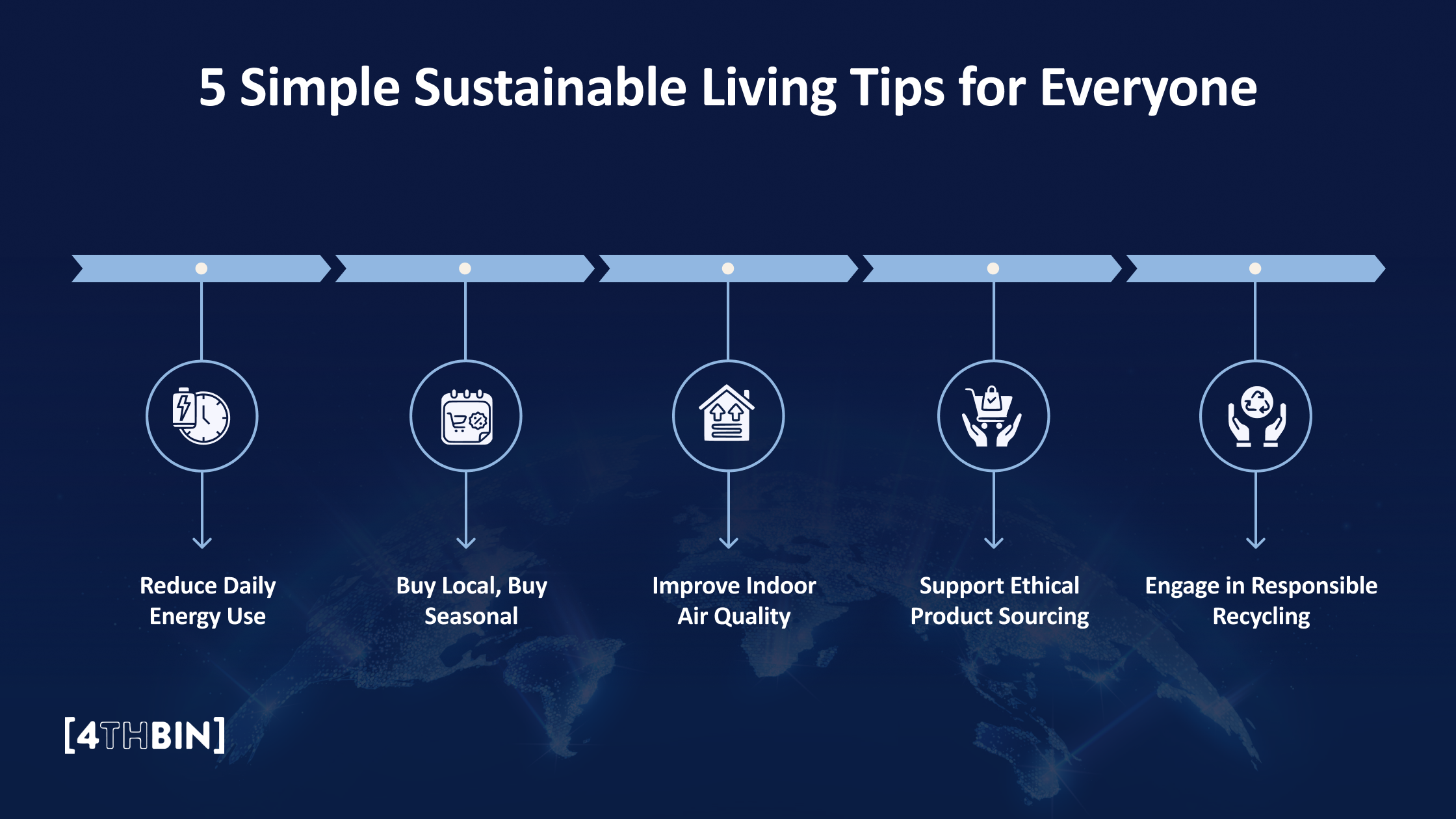
Here are some of the most direct, achievable ways to adopt sustainable living habits that reduce environmental harm. These steps support large-scale goals like the SDGs and strengthen compliance with evolving ecological standards.
Reduce Daily Energy Use
Lowering power use is one of the most effective ways to reduce emissions. Start by reviewing how energy is used during regular operations. Lighting, heating, air-conditioning, and plug loads from devices form the bulk of non-industrial energy demand.
Using energy-efficient appliances, upgrading insulation, and optimizing usage schedules can lower consumption without reducing performance.
Here are key ways to cut your daily energy load:
- Replace old bulbs with LEDs, which consume 75% less energy.
- Install motion sensors in rooms with intermittent use, like conference halls or storerooms.
- Program thermostats to reduce heating or cooling during non-peak hours.
- Unplug chargers and non-critical devices at end-of-day to cut phantom loads.
- Enable “sleep mode” or “eco mode” in equipment.
One overlooked area is refrigeration. For example, office kitchens with multiple underused mini-fridges consume unnecessary energy. Consolidating to a single energy-efficient model reduces load and simplifies maintenance.
Another tip is to use natural light as much as possible. Offices and homes with access to daylight can reduce artificial lighting during work hours. Window placement, reflective surfaces, and glass partitions help amplify light spread. This not only saves power but improves work quality and wellbeing.
Buy Local, Buy Seasonal
Sourcing goods from nearby regions reduces emissions from long-distance shipping and supports regional economies. Produce grown in-season is fresher, less dependent on artificial preservatives, and often requires less energy for storage and transport. Food mileage, or the distance food travels from farm to consumer, directly correlates with environmental cost.
Urban buyers can access seasonal produce via farmers' markets, community-supported agriculture (CSA) programs, or direct delivery from local farms. Local food systems also enable traceability, making verifying environmental practices used in cultivation or processing easier.
Transporting goods over long distances contributes to carbon output, particularly for air freighted items. By choosing local, emissions from logistics chains can be reduced sharply. For example, strawberries flown in off-season from overseas emit up to ten times more CO₂ than locally grown varieties in season.
Establishing procurement protocols that prioritize local vendors also contributes to economic sustainability. Regional businesses are more likely to reinvest profits within the community and uphold local employment standards.
The practice extends beyond food. Supporting nearby clothing, household items, and services producers ensures a tighter environmental and ethical loop. Businesses and individuals should maintain seasonal buying calendars and coordinate purchasing to align with natural availability.
Improve Indoor Air Quality
Poor air quality in enclosed spaces affects respiratory health, focus, and long-term wellness. Maintaining clean, pollutant-free air is vital in both office and residential spaces. Indoor pollution sources include off-gassing from furniture, poor ventilation, mold, and the use of harsh cleaning agents.
Regular monitoring, proper air circulation, and choosing the right materials and plants can help mitigate indoor pollutants. Here is a quick reference for standard solutions:
|
|
|
|
|
|
|
|
|
|
|
|
|
|
|
|
|
|
|
|
|
|
|
|
|
|
|
|
Simple upgrades, such as installing air purifiers or introducing indoor plants like snake plants or peace lilies, can absorb toxins and increase oxygen levels. Ensure that all HVAC systems are maintained semi-annually to avoid microbial buildup.
A quarterly IAQ (Indoor Air Quality) report using certified monitors can support documentation and regulatory compliance.
Support Ethical Product Sourcing
Ethical sourcing guarantees that the materials and labor behind a product meet environmental and human rights standards. It aligns purchasing decisions with values such as fair labor, supply chain transparency, and ecological responsibility.
Before purchasing textiles, electronics, or food, evaluate the supplier’s environmental certifications (e.g., Fair Trade, Rainforest Alliance, B Corp). Third-party verifications provide traceable data to confirm claims around sustainable inputs, fair wages, and safe working conditions.
For instance, choosing apparel made from organic cotton ensures minimal pesticide use and lower water consumption. Likewise, electronics manufacturers prioritizing conflict-free minerals or circular economy models are less likely to exploit labor or generate hazardous e-waste.
Develop a vendor assessment checklist that includes sourcing location, material lifecycle, and end-of-life disposal methods. Introduce Supplier Codes of Conduct for procurement teams to standardize expectations across all purchasing categories.
Ethical sourcing is all about aligning operational behavior with environmental and social goals. Product origin, labor conditions, and material impact are no longer secondary—they are core to procurement decisions.
Engage in Responsible Recycling
Recycling supports waste diversion and conserves natural resources. Yet, recyclable waste often ends up in landfills or oceans without proper sorting, collection, and disposal channels. To ensure compliant handling, engage with certified recycling partners, particularly for hazardous or electronic waste streams.
Responsible recycling also supports several Sustainable Development Goals (SDGs). Here is the SDG Pyramid, showing how recycling contributes to global sustainability objectives:
Recycling directly addresses Goal 12 (Responsible Consumption and Production) by minimizing the extraction of raw materials. It also supports Goal 13 (Climate Action) through emissions reductions and Goal 6 (Clean Water and Sanitation) by keeping waste out of ecosystems.
Partner with certified providers for electronic waste, such as 4THBIN, which delivers data-secure, environmentally compliant disposal services. Electronic waste is the fastest-growing waste stream worldwide, and improper handling poses risks to environmental integrity and data security.
Engaging qualified recyclers helps ensure compliance with data privacy regulations and environmental mandates. When selecting a vendor, prioritize those certified under recognized standards such as e-Stewards or R2 (Responsible Recycling, which validate responsible processing and downstream accountability.
Circular Economy in Action: Beyond Reduce, Reuse, Recycle
As sustainability moves from a peripheral goal to a central business and policy mandate, the circular economy emerges as one of its most effective implementation models. While responsible recycling supports several Sustainable Development Goals, a truly sustainable future demands a more systemic shift—from linear consumption patterns to circular design and operations.
The circular economy extends beyond the familiar reduce, reuse, recycle mantra. It redefines how products are created, used, and returned to the system—aiming to eliminate waste, retain value, and regenerate natural systems. In this model, products are created for durability, materials are selected for recovery, and systems are optimized for continuous use.
This approach directly supports environmental sustainability by reducing extraction and emissions, aligns with economic sustainability through resource efficiency and cost savings, and contributes to social sustainability by fostering local repair economies and reducing exposure to pollution.
For forward-thinking businesses and conscious consumers alike, the question is no longer whether we should move toward circularity but how quickly we can redesign our systems to support it. True sustainability lies not just in reducing harm but in creating lasting, regenerative value at every level.
Take the First Step Toward Sustainability with 4THBIN
Starting your sustainability journey begins with responsible e-waste disposal. Choosing a certified recycler like 4THBIN ensures your environmental efforts are impactful, fully compliant with e-waste regulations, and secure for your organization.
With over ten years of industry expertise, 4THBIN has supported more than 10,000 businesses—from agile startups to global Fortune 100 companies—in managing their electronic waste sustainably. Our services help transform e-waste from an environmental challenge into a leadership opportunity for your brand.
We provide certified data destruction that guarantees your sensitive information remains protected, eliminating risks tied to improper disposal. If you prefer our secure RemoteReturn mail-in program or on-site pickup services, our flexible options are designed to meet your organization's unique needs.
Contribute to a more sustainable future.
Contact Us