How to Reduce Your Organization’s Tech Carbon Footprint
Today, technology is an integral part of any modern business; it is as essential as oxygen, though its environmental impact is detrimental. Therefore, as digital infrastructure expands to support cloud computing, AI, and always-on connectivity, organizations are being compelled to confront a tech carbon footprint that is both massive and accelerating.
Independent studies conducted between 2018 and 2021 placed the Information and Communication Technology (ICT) sector’s share of global greenhouse gas emissions at roughly 1.8% to 2.8%. However, adjusted lifecycle estimates, which account for everything from raw material extraction to hardware disposal, suggest a range of 2.1% to 3.9%.
More recent figures confirm that the sector consistently contributes around 2% to 3% of global emissions, a share that continues to rise as data centers and power-intensive AI workloads expand. This footprint now places the global tech sector on par with the aviation industry, driven by rapid hardware refresh cycles and underreported supply chain emissions.
Reducing this impact is no longer a future ambition; it is a present-day responsibility shaped by regulations, investor scrutiny, and rising ESG expectations.
In this blog, we’ll discuss where these emissions actually originate, the hidden environmental costs of rapid digital scaling, and the practical steps your organization can take to build a more sustainable, high-performance tech stack.
Understanding the Scope of a Tech Carbon Footprint
A tech carbon footprint extends far beyond the electricity used to power devices or servers. It includes emissions generated throughout the lifecycle of technology assets, from raw material extraction and manufacturing to transportation, use, and end-of-life disposal.
This is where many organizations underestimate their impact. Research consistently shows that the majority of a device’s lifetime emissions occur before it is ever used, during mining, production, and assembly.
For example, the carbon footprint of a smartphone or laptop is overwhelmingly front-loaded, meaning frequent replacement locks in unnecessary emissions.
Under global emissions frameworks such as the Greenhouse Gas Protocol, these impacts fall broadly under Scope 3 emissions, which include supply chain activities, outsourced manufacturing, logistics, and waste processing, especially in the technology sector.
In the upcoming section, we’ll understand it all in detail.
Understanding Scope 3 Emissions in Tech
Carbon accounting frameworks such as the Greenhouse Gas Protocol divide emissions into three scopes. For technology-driven organizations, the most significant risks almost always sit outside direct operations.
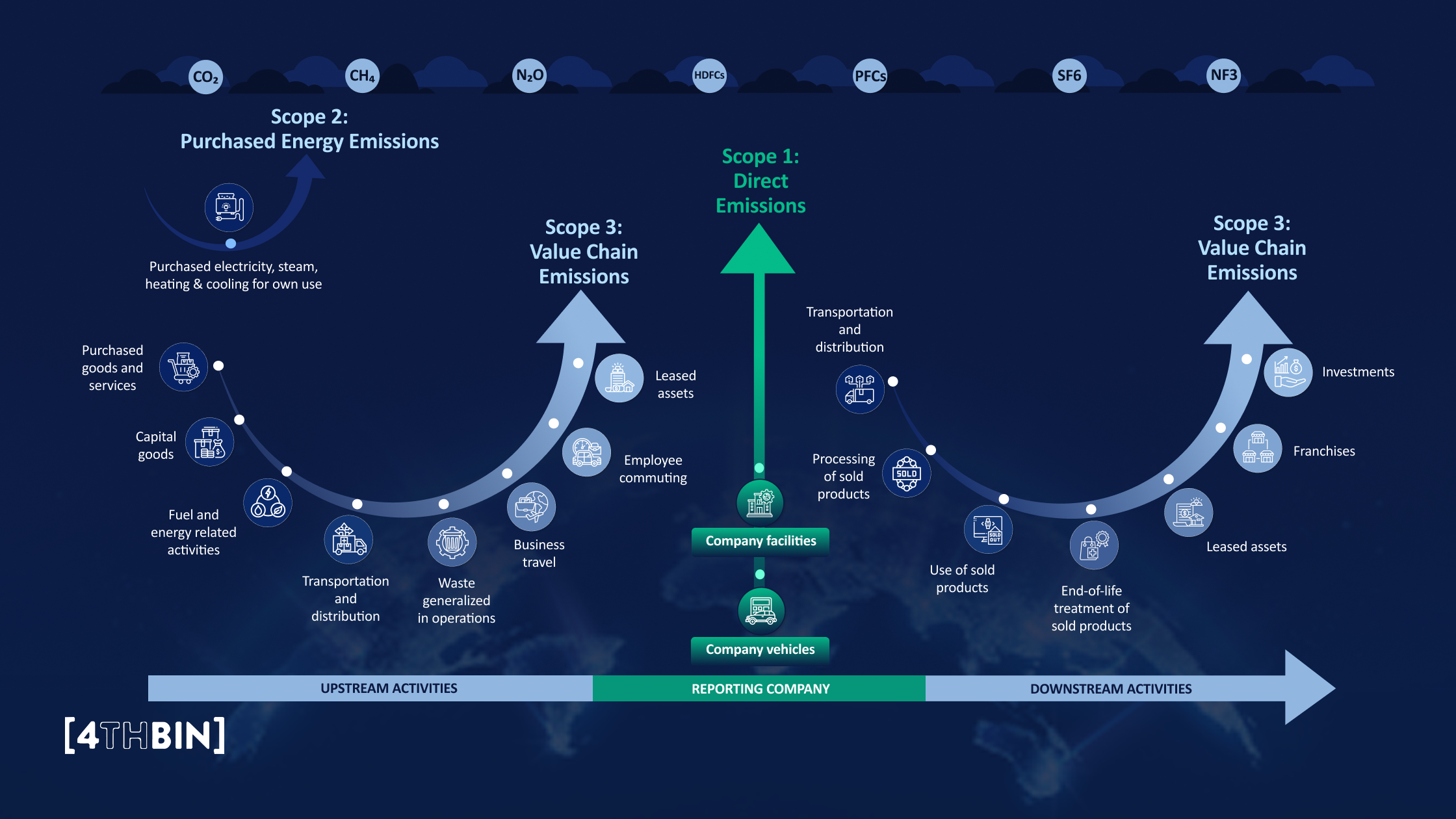
Here’s how a tech carbon footprint typically breaks down:
Scope 1: Direct Emissions
Emissions from owned or controlled sources, such as onsite fuel use or heating systems. For most tech organizations, this is a relatively small portion of total impact.
Scope 2: Purchased Energy Emissions
Emissions are tied to electricity, heating, and cooling. This includes offices and data centers, which can be energy-intensive, especially as AI and cloud workloads scale.
Scope 3: Value Chain Emissions
This is where the majority of tech-related emissions live. It includes:
- Manufacturing of hardware and components
- Raw material extraction (metals, rare earths, plastics)
- Transportation and logistics
- Product use and end-of-life disposal
Research consistently shows that Scope 3 emissions dominate the tech sector’s footprint, yet they are the least consistently reported and the easiest to understate.
Environmental & Social Impact of Data Center Expansion
Data centers power modern AI and cloud services, but their real footprint shows up locally. In this section, we’ll understand how both the environmental load and the community-level impacts are often overlooked.
Hidden Environmental Cost of Data Centers
Data centers are among the most resource-intensive parts of the digital economy, and AI workloads are accelerating their growth. What looks like “invisible infrastructure” on the user side becomes very visible on the ground: heavy electricity draw, primary water demand for cooling, and large land footprints that reshape local geographies.
- Electricity at neighborhood-to-city scale: Conventional data centers can rival 10,000–25,000 households in power demand, while AI-focused hyperscale facilities can climb far higher, driving grid strain and new infrastructure buildouts.
- Water use that can rival municipalities: Larger facilities may require millions of gallons per day, much of it tied to cooling, creating real basin-level pressure.
- Land conversion + hard surfaces: New builds can span hundreds of acres, displacing farmland or habitat and adding transmission corridors, substations, and related infrastructure.
- Not just operational emissions: The footprint includes construction materials (steel/cement) and the upstream impacts of server and chip manufacturing, as well as refresh cycles.
Human Rights and Environmental Justice Impacts
The UAB framing is aggressive because it shifts the conversation from “resource use” to human rights and lived consequences, water access, utility affordability, public health, and who absorbs the risk when rapid buildouts happen in rural areas.
- Water access + infrastructure burden: Cooling demand can increase pressure on local water systems, potentially triggering upgrades, and communities worry about where costs land.
- Grid strain and household costs: Rising demand can mean more upgrades and higher bills, especially where electricity is already expensive, or infrastructure is storm-vulnerable.
- Public health risks from diesel and fossil reliance: Backup generators and fossil-heavy power can worsen local air quality, with health impacts that often fall hardest on communities already facing environmental burdens.
- Jobs vs. long-term footprint: Construction creates a surge of work, but ongoing operations can be far smaller than expected, building tension over whether local benefits match local costs.
How Extended Producer Responsibility (EPR) Is Reshaping Accountability in Tech
If data centers reveal where tech emissions are concentrated, Extended Producer Responsibility (EPR) explains who is accountable once technology reaches the end of its life.
Unlike disclosure frameworks that focus on measuring emissions, EPR shifts responsibility to outcomes. It requires organizations to take ownership of what happens to technology assets after they are retired, reused, refurbished, or discarded.
This shift exists because the scale of e-waste is no longer manageable through voluntary action alone. According to the Global E-waste Monitor, the world generated over 62 million metric tons of electronic waste in 2022. Less than 23 percent was formally collected and recycled. The rest was landfilled, exported, or processed through informal channels that pose serious environmental and health risks.
EPR frameworks were created to close this gap and prevent technology from becoming an unmanaged carbon and waste liability.
What EPR Changes in Practice
Under EPR regulations, responsibility does not end when a device leaves service. Organizations are increasingly expected to finance, manage, and document the collection, reuse, refurbishment, or recycling of electronic equipment.
This matters because electronics contain high-impact materials. The United Nations estimates that global e-waste includes recoverable materials worth more than $60 billion annually, including copper, aluminum, gold, and rare earth elements. When devices are discarded without recovery, both material value and the carbon invested in extraction and manufacturing are permanently lost.
EPR is developed to keep those materials in circulation and to reduce the need for new, carbon-intensive production.
Why EPR Applies to Organizations and Not Just Manufacturers
While EPR is often associated with producers, its impact increasingly falls on large technology users: enterprises, data center operators, healthcare systems, and financial institutions.
Most e-waste regulations are triggered by who places equipment into circulation or retires it, not just who originally manufactured it. As a result, organizations managing technology at scale now face direct responsibility for compliant end-of-life outcomes.
In practical terms, this means organizations must be able to:
- Ensure retired devices are processed through approved recovery or recycling programs
- Provide documentation showing reuse, refurbishment, or certified recycling
- Account for e-waste volumes tied to compliance fees or reporting requirements
These obligations exist because manufacturing and disposal drive the majority of tech emissions. Research consistently shows that most of a device’s lifetime carbon footprint occurs before it is ever used, during mining, manufacturing, and assembly. EPR directly targets this impact by discouraging premature replacement and improving recovery outcomes.
How EPR Is Expanding & Creating an Impact
EPR is no longer fragmented or optional. It is expanding globally, and enforcement mechanisms are becoming more formalized.
- United States: More than 25 states have electronics recycling laws rooted in EPR laws, with increasing pressure on large organizations to demonstrate traceable, compliant disposal.
- European Union: The WEEE Directive enforces producer and downstream responsibility with mandatory reporting and recovery targets. The EU achieved formal e-waste collection rates of 40.6 percent in 2022 (still 65% below the target set by the WEEE Directive), nearly double the global average.
- Asia-Pacific: Countries such as India, Japan, and South Korea have strengthened EPR frameworks that include take-back mandates and digital tracking of e-waste flows.
Across regions, the direction is consistent: organizations are expected to manage the full lifecycle impact of their technology, not just its operational phase.
Why EPR Changes the Tech Carbon Conversation
EPR closes a critical gap between sustainability reporting and real-world action. While disclosure frameworks show where emissions exist, EPR defines what must happen at the most carbon-intensive stages of the technology lifecycle.
By enforcing responsible reuse, refurbishment, and recycling, EPR:
- Reduces demand for new raw material extraction
- Prevents hazardous substances from entering landfills
- Lowers lifecycle emissions tied to premature replacement
- Forces operational discipline around asset retirement
In effect, EPR turns sustainability from a reporting exercise into an operational requirement.
Once responsibility is clearly defined, the path forward becomes practical: extend what you can, recover what you should, and document every outcome. That is where technology lifecycle management moves from intent to measurable impact.
That’s where disciplined technology lifecycle management moves from sustainability intent to measurable impact.
7 Actionable Ways to Reduce Your Organization’s Tech Carbon Footprint
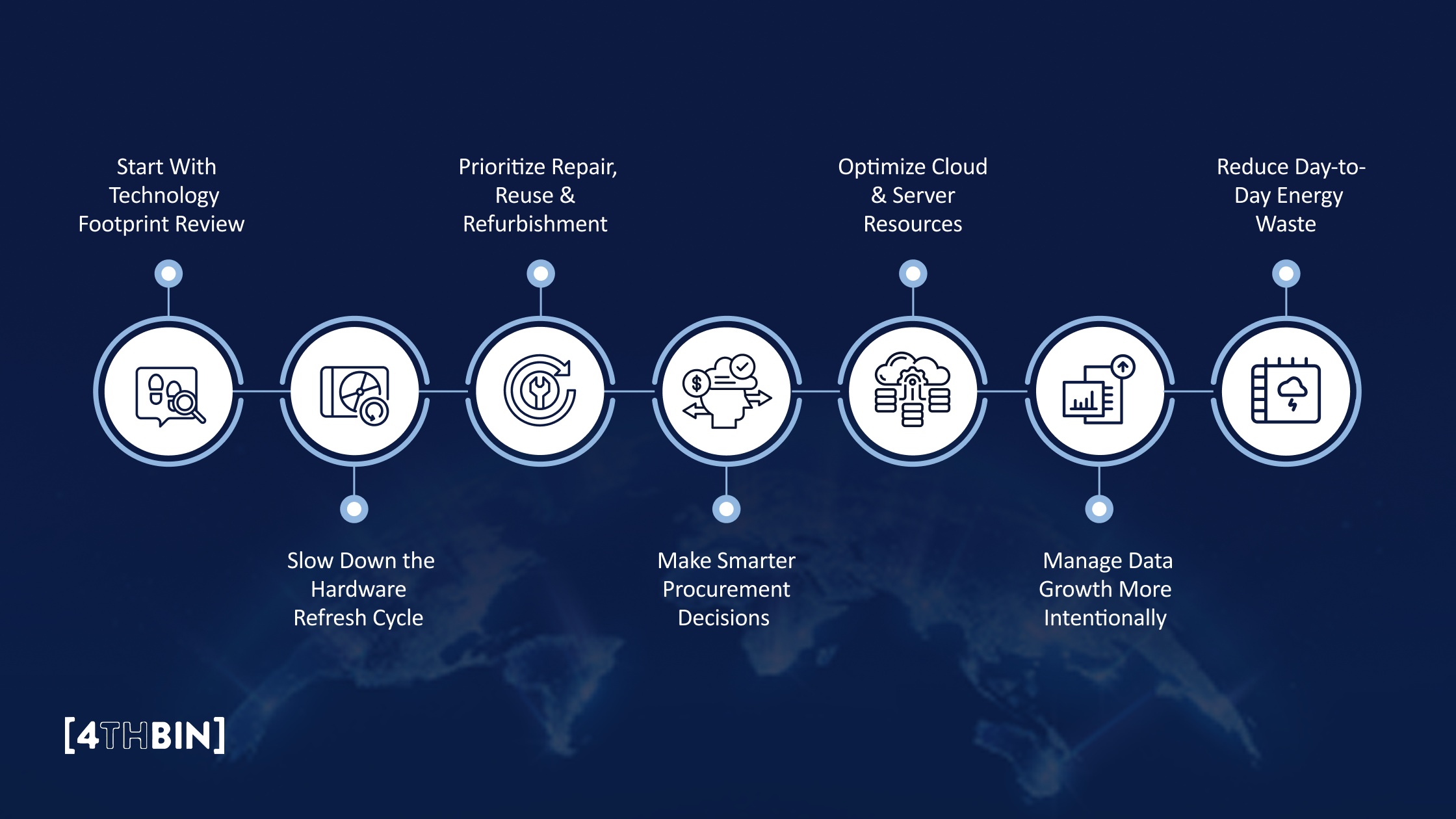
Reducing your tech carbon footprint doesn’t require perfect measurements. It requires operational changes across the technology lifecycle, because that’s where most tech emissions actually sit. That’s why the actions below focus on lifecycle decisions that enable organizations to reduce emissions quickly without sacrificing performance.
Below is a practical, “do-this-next” framework you can apply across IT, procurement, security, and sustainability teams.
1) Start With Technology Footprint Review
A significant share of device emissions occurs before first use, during extraction, manufacturing, and shipping. When organizations refresh too early, they repeatedly re-trigger those embodied emissions.
How to put this into practice:
- Replace fixed refresh schedules with condition-based refresh (performance needs, battery health, repair history, role type).
- Create device tiers by role so high-spec hardware is reserved for high-need users (e.g., engineering/design vs. standard office roles).
- Build a repair-first workflow:
- standardized diagnostics
- approved repair partners
- spare accessories and parts planning where applicable
- Set an internal KPI like “average device lifespan” and increase it gradually (quarter over quarter).
What improves when you do this:
- Fewer new device purchases
- Lower embodied Scope 3 emissions
- Reduced e-waste and lower IT spend volatility
2) Slow Down the Hardware Refresh Cycle
Many companies reuse informally, but this informal reuse often creates untracked risk: devices sit idle, inventory gets messy, and assets quietly depreciate without delivering value.
Turn reuse into a system:
→ Define a redeployment ladder:
- Tier 1: primary users
- Tier 2: secondary roles/shared stations
- Tier 3: refurbish/recover value externally
→Standardize a wipe → verify → reissue process (fast and consistent).
→Track readiness with simple rules:
- age and condition thresholds
- minimum security capability (encryption, endpoint protection compatibility)
- eligibility by role
What improves when you do this:
- Higher utilization per device
- Faster onboarding without buying net-new hardware
- Better governance, fewer “lost” assets
3) Prioritize Repair, Reuse & Refurbishment
Overprovisioning is one of the most common drivers of unnecessary emissions and cost. Idle devices and unused licenses are obvious waste; idle cloud workloads can quietly become the largest line item.
Where to start (high-impact audits):
- Endpoints: devices not checked in for 30–60 days
- SaaS: licenses assigned but unused
- Cloud: always-on dev/test, oversized instances, orphaned storage
Controls that keep it from returning:
- Auto-reclaim licenses after inactivity
- Approval gates for new tools (prevents duplication)
- Budget + usage alerts for cloud resources
- Scheduled shutdown policies for non-production environments
What improves when you do this:
- Reduced Scope 2 energy demand from avoidable computing
- Fewer purchases because reclaimed assets fill gaps
- More apparent connection between tech spend and footprint
4) Make Smarter Procurement Decisions
Procurement is where your future footprint gets locked in. If you buy purely for speed and performance, you usually buy more and replace more often.
Procurement standards that reduce lifecycle emissions:
- Prioritize durability and repairability (warranty length, parts availability, service network)
- Adopt a refurbished-first policy for eligible teams and roles
- Require vendor transparency (take-back programs, disposal documentation, lifecycle reporting where possible)
- Standardize models to simplify maintenance, parts, and redeployment
What improves when you do this:
- Lower refresh frequency
- Simpler inventory and lifecycle management
- More substantial Scope 3 reporting defensibility
5) Optimize Cloud & Server Resources
Even if you don’t control hyperscale infrastructure, you can control demand drivers, especially from high-compute workflows and “always-on” storage habits.
Low-friction improvements:
- Set guidelines for high-compute use cases (avoid redundant AI calls, unnecessary generations, excessive retraining)
- Implement retention and archiving policies (reduce storage bloat)
- Use batching, caching, and scheduling where feasible
- Reduce duplicate backups and unmanaged data sprawl
What improves when you do this:
- Reduced cloud energy demand and cost
- Better governance over where compute is being consumed
6) Manage Data Growth More Intentionally
End-of-life is where carbon reporting, compliance, and security exposure intersect. If you can’t prove what happened to assets, your ESG claims weaken, and your risk increases.
Non-negotiables for responsible end-of-life:
→ Certified data destruction with chain-of-custody documentation
→ Prioritize refurbishment and recovery before recycling
→ Verified recycling standards and transparent downstream handling
→ Disposition tracking that shows outcomes:
- Reused/refurbished
- Recovered
- Recycled
- Disposed (minimize)
What improves when you do this:
- Cleaner Scope 3 reporting and audit readiness
- Lower data risk from unmanaged disposal
- Measurable reduction in waste and landfill exposure
7) Reduce Day-to-Day Energy Waste
This can’t live as a one-off sustainability initiative. It has to become a standard operating system across IT and procurement.
Simple governance that works:
→ An IT lifecycle policy (refresh, reuse, disposal, vendor requirements)
→ Named owners across IT + procurement + security + ESG reporting
→ Quarterly reviews of:
- Average device lifespan
- Reuse/refurbishment rate
- Verified end-of-life documentation coverage
- Procurement volumes and refresh drivers
Governance is the difference between good intentions and measurable outcomes. Once you’ve defined lifecycle rules, assigned ownership, and established review cadence, the next challenge is execution at scale, especially in the two areas where organizations face the greatest risk and the most considerable Scope 3 impact: asset extension and end-of-life handling.
That’s also where many sustainability strategies break down. Devices don’t retire themselves. Data can’t be destroyed casually. And ESG reporting can’t rely on assumptions; stakeholders increasingly expect documentation, traceability, and proof that your technology lifecycle is being managed responsibly.
To turn accountability into impact, organizations need an operational partner that can:
- Securely process assets without creating compliance risk
- Maximize reuse and recovery before recycling
- Provide auditable records for ESG and security teams
- Prove outcomes with consistent, repeatable workflows
That’s where 4THBIN comes in.
Reduce Your Organization’s Tech Carbon Emissions With 4THBIN
Carbon visibility matters only if it drives real operational change. That’s where follow-through counts. At 4THBIN, we help organizations turn technology management into a measurable sustainability advantage by addressing the most carbon-intensive stages of the IT lifecycle.
Through secure, certified data destruction, IT asset disposition & recovery, and e-recycling, we ensure technology assets are managed responsibly without compromising security or compliance.
By extending asset lifespans and ensuring transparent end-of-life management, organizations can reduce Scope 3 emissions, strengthen ESG disclosures, and move beyond surface-level sustainability claims. Lower-carbon technology strategies don’t start with promises. They start with better lifecycle decisions and partners who can prove impact.
Reducing your tech carbon footprint is one of the most immediate and defensible ways to advance ESG goals. It cuts emissions, strengthens governance, and demonstrates accountability where stakeholders are paying the closest attention.
If you’re ready to reduce emissions, cut waste, and build a more responsible IT lifecycle, our team is here to help.
Partner with 4THBIN today!