Why Sustainable Tech Disposal Must Be at the Top of Your Business Agenda
Your business may be scaling, turning profits, earning recognition, or even reaching global clients. That’s expected. But today, success can’t be measured by numbers alone. Growth means little if sustainability isn’t a conscious, ongoing commitment.
Each year, more than 54 million metric tonnes of electronic waste are generated globally, according to the United Nations Environment Programme and its partners. A significant portion comes from businesses, and only about 17 percent is recycled responsibly. It’s an uncomfortable reality, but one that leadership can’t ignore. Growth without responsibility leaves a footprint, and someone always bears the cost.
This is where sustainable tech disposal becomes a leadership decision, not an operational task. It’s where data security, environmental responsibility, compliance, and long-term accountability intersect. Treating disposal as an afterthought isn’t neutral anymore. It’s a choice.
How a business retires its technology says a lot about the future it’s trying to build. Growth that ignores what it leaves behind isn’t progress. It’s deferred accountability.
In this blog, we’ll explain why sustainable tech disposal must be a deliberate business choice, and how approaching it with the same intent as innovation and scaling leads to growth that’s responsible, defensible, and built to last.
The E-Waste Problem with Businesses Today
E-waste is the fastest-growing waste stream worldwide, with over 62 million tonnes generated annually. Businesses contribute heavily through frequent hardware refresh cycles, short device lifespans, and expanding data center infrastructure, creating a significant environmental and resource-depleting issue.
Sustainable Tech Disposal As a Business Necessity
Treating disposal as a purely environmental concern misses the larger picture. Poor disposal practices introduce tangible business risk.
From a data security standpoint, retired devices often still contain sensitive information. Without verified data destruction, organizations expose themselves to breaches long after assets leave their facilities.
From a compliance perspective, e-waste and ESG regulations are tightening globally. Regulators and auditors increasingly expect proof of responsible end-of-life handling, not informal assurances.
From an ESG credibility standpoint, claims collapse fast when end-of-life outcomes can’t be documented. If disposal outcomes can’t be reported, trust erodes quickly.
And financially, improper disposal destroys value. Devices with remaining usable or recoverable materials are often written off unnecessarily, increasing costs and waste.
Sustainable tech disposal protects the business while protecting the planet.
Why Organizations Struggle with Effective Disposal Practices
Despite good intentions, most businesses struggle with execution. Disposal processes are often fragmented across vendors. Documentation is inconsistent. Devices sit idle or disappear from inventory. Internal teams lack time, tools, or expertise to manage disposal at scale.
The result is risk accumulation, not risk reduction.
The gap is rarely intended; it’s an operational control issue. Without clear ownership, consistent tracking, and reliable downstream partners, disposal turns into an inventory blind spot and a compliance risk.
Many businesses recognize the importance of sustainable tech disposal, but execution often falls short. Common pitfalls include fragmented processes, inconsistent documentation, and a lack of centralized tracking, leading to risk accumulation instead of reduction.
Without clear ownership and reliable partners, businesses face growing compliance risks, inventory blind spots, and potential data breaches.
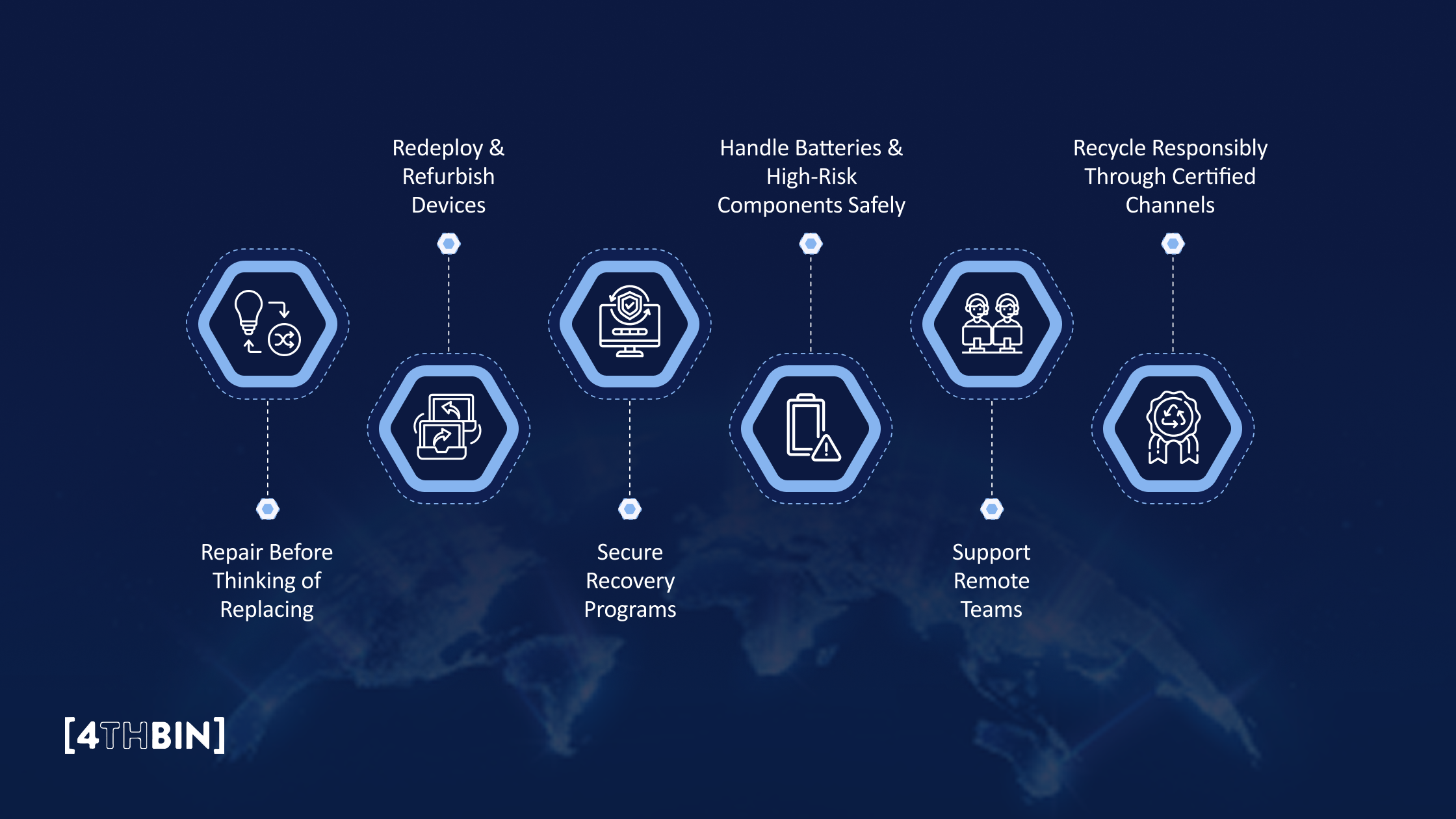
Fortunately, proven strategies exist to address these challenges. Here are 6 easy ways to practice sustainable tech disposal.
6 Ways to Practice Sustainable Tech Disposal Efficiently
For individuals, sustainable tech disposal often means fixing a device, selling it online, or dropping it at a local recycler. For businesses, especially those managing hundreds or thousands of assets, the approach must be structured, secure, and auditable.
This is where informal methods break down, and enterprise-grade processes matter. Sustainable tech disposal at scale requires clear workflows, certified handling, and partners that can manage risk, compliance, and environmental outcomes together.
1. Repair Before Thinking of Replacing
The most sustainable device is the one you do not replace prematurely. For businesses, this means shifting from rigid refresh cycles to condition-based decisions.
Through dedicated IT asset disposition and recovery (ITAD) programs, organizations can assess retired or aging equipment to determine whether devices can be repaired, upgraded, or restored to working condition. This approach extends asset life, reduces e-waste, and avoids re-triggering the embedded emissions from manufacturing new hardware.
By prioritizing recovery over replacement, companies lower both environmental impact and capital spend.
2. Redeploy & Refurbish Devices
Not every device needs to serve its entire life in a single role. Hardware that no longer meets the needs of power users can often be redeployed to secondary roles, shared workstations, or temporary teams.
When internal reuse is no longer viable, however, certified refurbishment allows devices to be securely wiped, tested, repaired, and reintroduced into circulation. Refurbishment preserves value, reduces demand for new materials, and supports circular economy goals, all while maintaining performance and reliability standards.
This keeps technology in use longer, before recycling becomes the final option.
3. Secure Recovery Programs
Consumer resale platforms may extend device life, but they are not designed for enterprise risk. Businesses require verified data destruction and auditable handling before any device leaves their control.
Moreover, through structured asset recovery programs, organizations can recover value from surplus equipment without exposing sensitive data or losing visibility. Devices are processed securely, outcomes are documented, and resale or reuse happens within controlled, compliant channels.
This eliminates the risks associated with unmanaged resale while still supporting sustainability and value recovery.
4. Handle Batteries & High-Risk Components Safely
Batteries are among the highest-risk components in electronic waste. Improper handling can lead to fires, environmental contamination, and safety incidents.
Enterprise disposal programs account for battery removal, separation, and recycling through appropriate channels, ensuring compliance with transportation and environmental regulations. This level of care is challenging to achieve through ad hoc disposal but essential for sustainable tech disposal at scale.
5. Support Remote Teams
Modern workforces are increasingly distributed, making asset return and disposal more complex. Devices may never return to a central office, increasing the risk of loss, improper disposal, or data exposure.
Device return and mail-back programs allow organizations to securely collect retired equipment from remote employees, ensuring consistent disposal standards regardless of location. This keeps sustainability, security, and compliance aligned across the entire workforce.
6. Recycle Responsibly Through Certified Channels
When devices can no longer be repaired, reused, or refurbished, recycling becomes the final step, but only if it’s done through certified, accountable channels. Responsible electronics recycling ensures hazardous materials are handled safely, valuable materials are recovered, and end-of-life outcomes remain compliant and traceable as e-waste regulations expand across states and regions.
Recycling Only Counts If It’s Done Responsibly
Recycling is often treated as the “safe default” for retired technology, but the reality is that not all recycling is responsible. Without clear standards and downstream transparency, your old office hardware can still end up in a landfill, exported illegally, or processed in ways that cause massive environmental and human harm.
Actually doing sustainable tech disposal requires more than just a “recycling” label. It requires proof. To truly move the needle on ESG, responsible electronics recycling must include:
Certified recycling standards: Don't just take their word for it. Work only with recyclers certified under recognized programs like R2 (Responsible Recycling) or e-Stewards. These certifications ensure the facility is held to strict, third-party audited environmental and safety requirements.
Secure removal of hazardous components: Electronics are a cocktail of chemicals. Every year, improper disposal releases an estimated 58,000 kg of mercury and 45 million kg of toxic plastics into the environment. Batteries and components containing lead, mercury, and cadmium must be separated and processed through specialized channels to prevent fires and soil contamination.
Documented chain of custody: You need to know precisely where your data-bearing assets are at all times. This means tracking devices from the moment they leave your dock to their final processing point.
Verified downstream handling: A recycler is only as good as their partners. Responsible vendors provide transparency into where materials go after they leave their facility, ensuring they aren’t just dumped in informal markets.
Clear disposition reporting: At year-end, you should be able to account for every kilogram of tech. Your reports should clearly show what was:
- Reused or refurbished (the highest form of sustainability)
- Materials recovered (e.g., recycling 1 million laptops saves enough energy to power 3,500 homes for a year)
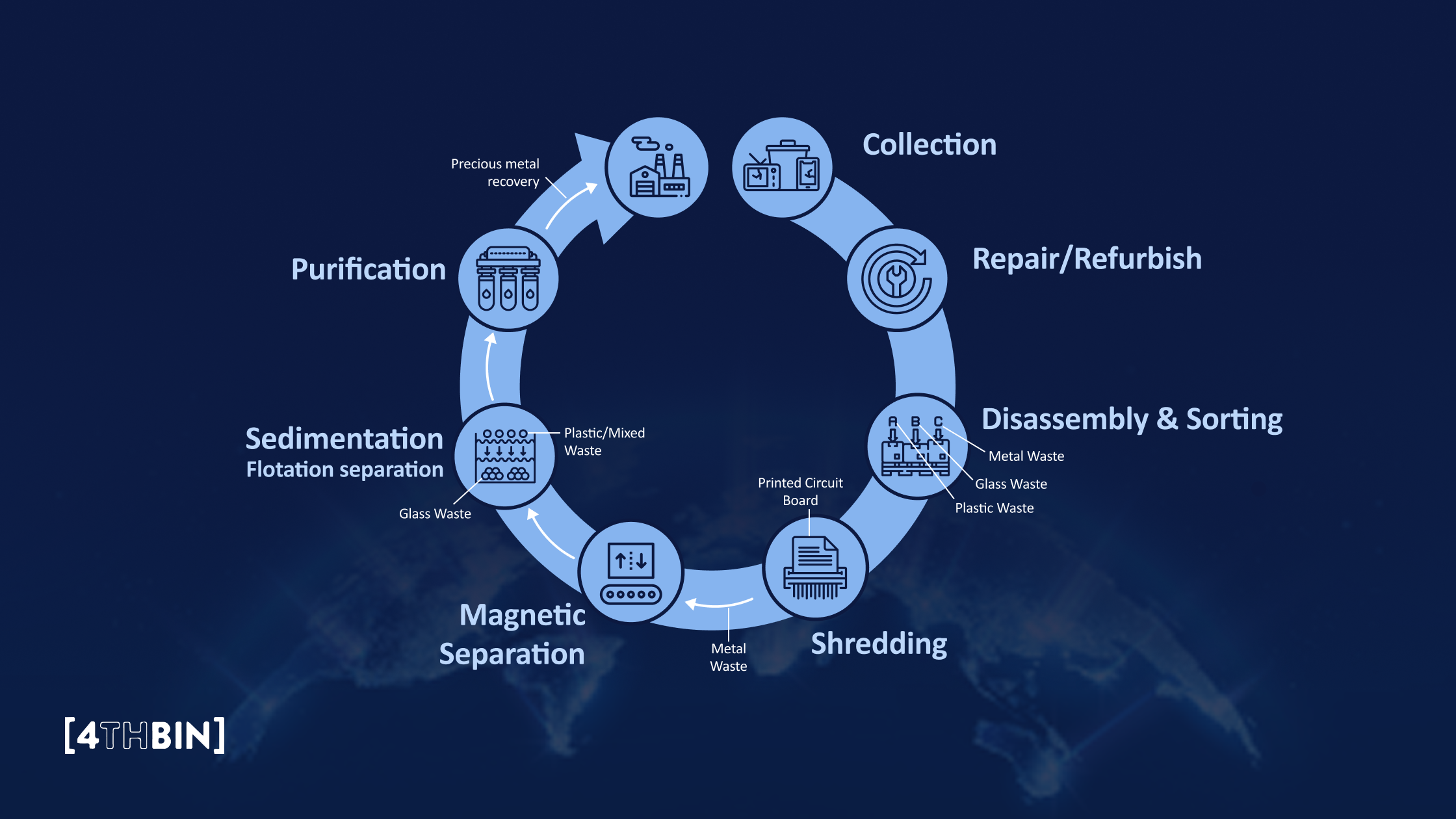
- Recycled (illustrated below is a verified sustainable ITAD lifecycle, ensuring transparency from retirement to material recovery)
- Disposed (only as an absolute last resort)
Without these safeguards, recycling becomes another blind spot rather than a sustainability solution.
Sustainable tech disposal delivers real ESG value by producing measurable outcomes. Environmentally, it reduces waste, lowers emissions, and supports material recovery. Socially, it prevents toxic exposure and unsafe recycling practices. From a governance standpoint, it creates traceability, audit readiness, and accountability.
But measurement alone isn’t enough. To translate intent into impact, organizations need structured processes, certified handling, and consistent documentation across every stage of the technology lifecycle. Without an execution layer, even the strongest disposal policies remain theoretical.
That’s where sustainable tech disposal moves from principle to practice. And 4THBIN is here to help you with that.
Make Sustainable Tech Disposal a Business Advantage With 4THBIN
At 4THBIN, we help organizations operationalize sustainable tech disposal through integrated services that address the most critical lifecycle stages. Certified data destruction ensures sensitive information is permanently eliminated. IT asset disposition and recovery programs prioritize reuse and refurbishment before recycling. Responsible electronics recycling ensures materials are handled safely and transparently.
Most importantly, every outcome is tracked and documented, providing organizations with the evidence they need for ESG reporting, compliance, and internal governance.
With the right processes in place, sustainable tech disposal becomes repeatable, auditable, and scalable rather than reactive.
Partner with 4THBIN to turn responsible disposal into measurable impact.